Thursday, October 29, 2009

Friday, October 23, 2009

Expand, Contract (16)

Now, what lately? Oh yeah, the final draft of GURPS Dungeon Fantasy: Summoners went in, and I reviewed the rough PDFs of a small Transhuman Space freebie that should appear in a little while. And I gather that someone else's Transhuman Space project of the moment is almost contracted for.

So I'm taking a short breather and dealing with some personal business before diving into a Pyramid article I've promised to write and deciding which projects are now at the top of my stack.

Monday, October 19, 2009

The Imaginarium of Doctor Parnassus

This is a movie about a man with the ability to give people access to the inside of his own imagination (or perhaps more their own imaginations - on this, as on other matters, it's a bit vague). That's slightly ironic, as the best reason to go see it is the chance to spend a couple of hours on the inside of Terry Gilliam's visual imagination.

It's a Gilliam film which reminds one of other Gilliam films, especially Time Bandits but also The Adventures of Baron Munchausen and others - his most visually fantastical efforts, perhaps. However, it's a bit skimpier on actual content even than those, let alone than some of his more serious creations. There's a plot and structure of sorts on offer, involving the power of story (actually questioned quite harshly here, unlike in many fantasy films in our current Gaimanian era, which makes a change) and a deal or two with a rather half-hearted devil, but I was left feeling that any time Gilliam felt that he might sacrifice some clarity in favour of another fancy CGI-assisted set-piece, he took the deal gladly.

The cast is very good, but they've been given a bunch of non-characters to play, with damn all in the way of consistency, a tendency to disappear when no longer needed, and back stories that are at best left largely to our imaginations - and in some cases, notably Verne Troyer's, any hint of an explanation has presumably ended up on the digital cutting-room floor (unless we get a hint at the end that Troyer is some kind of cut-rate guardian angel, which feels like a stretch). Christopher Plummer sticks to doing world-weary like the old trouper he is, while Lily Cole looks amazing, static or in motion (and can act, too), but she and Heath Ledger (and the latter's stand-ins where required) are, well, stuck with the script.

But, but, but... Terry Gilliam. Visual design. CGI aside, the margins and fringes of London have never looked more shabbily gothic (what would film-makers do without Battersea Power Station?), and the way that a faded carnival show can so easily and swiftly expand into a visual wonderland stands as a symbol of, well, something. Time spent here isn't wasted, at all. But it's strange experience to find yourself missing the satirical bite of Time Bandits or a Monty Python sketch.

Saturday, October 17, 2009

Life

Don't talk to me about life...

So the latest BBC natural history series is now up and running. Is it what we might expect? Rich-gravelly-paternal David Attenborough voic-eover: check. (Shame he's no longer up to getting out with the camera crews and sitting next to the animals, but that's, well, life.) Blimey-how-did-they-get-that-shot dazzling camerawork in incredibly difficult environments: check. Various weird, cute, or terrifying animals in action: check. (Inflatable eye-stalks? Whuh?) Some of those animals dying and getting eaten: check. (Time was when Spitting Image had a running joke about wildebeest seemingly existing solely to get eaten by lions on the beeb, but these days, technology spreads the pain around, and we get young penguins dying for our edification and a leopard seal's diet. Underwater.) Ten-minute show-your-working making-of snippet tagged on the end: check.

Going by the first installment, what it doesn't have is much of a theme, beyond This Is Life; it apparently no longer needs one. (Well, yes, inflatable eye-stalks - but why, really?) Frankly, its main functions are to justify the license fee and to sell HD televisions. Still, reports suggest that later installments settle into some kind of structure. And watching the darned thing (while Uncle Dave's commentary washes over), it can be hard to complain.

Monday, October 12, 2009

Up

As the leading exponents of a new media technology, Pixar make it their business to impress. Toy Story was a strong beginning; Monsters, Inc. demonstrated that they could show every hair on a furry creature; Ratatouille not only showed every hair on a rat, but showed every hair on a wet rat that had been struck by lightning; Wall-E featured grand vistas...

Up shows a photorealistic waterfall plunging off a Lost World plateau, a pack of semi-realistic dogs, and worn-out tennis balls covered in slime - all in immaculate 3D, if you go to the right screen. The humans are still more like plastic puppets, but I'd guess that Pixar won't try to change that until they can get to the far side of the uncanny valley in one titanic leap. Still, things are now getting to the stage that the cartoonish action sequences are looking markedly less plausible than anything else on the screen; increasingly realistic beings obeying unrealistic physics could become a problem. Though audiences used to modern action movies may not have too much trouble with this.

But that still leaves the question of the uses to which this synthetic realism is being put, which is becoming quite strange. Some critics have suggested that the protagonist of Up is a highly unlikely cartoon hero - a squat, grumpy geriatric. Actually, I suspect that "a cranky old man" would have seemed a perfectly reasonably lead character for, say, some of the classic Warner cartoons; it's only Pixar's connections with Disney that make it seem quite so strange, and heck, even Disney were noted for salting their emotional mix with the odd touch of sadness. But no, I don't think that any of the Golden Age Hollywood cartoon studios would have turned one of their movies into a wrenching meditation on aging, mortality, and the loss of dreams. (Not even if the tone shifted into something a little bit more conventional after half an hour or so.) But Up pushes its luck with the conventional cartoon audience fully that far; having the juvenile second lead turn out to come from a broken home, and then having the lead's lifelong hero prove to have been transformed by bitterness into a small-time Bond villain, end up looking like downright conventional touches. Another twist is to have the movie's talking animals - the dog pack - logically explained, and then to get a lot of good comedy from their pretty authentic canine psychology. (Mind you, after we've seen a whole furnished house wafted from North to South America under a cluster of party balloons, having anyone express surprise at a talking dog seems a bit of a cheek.)

Anyway, oh, yes, I nearly forgot - this is a good comedy, showing Pixar's customary eye for multiple details, with nary a clanking pop culture reference. The dogs get to provide most of the jokes, while also providing much of the practical menace; the leads are too busy being tragic. And Pixar do have some sympathy for the feelings of their younger audience members; on at least two occasions, some of the dogs should plunge to their dooms, but are granted soft landings instead. It's not a brutal film - just an oddly thoughtful one.

But where the heck are Pixar going to go next? Is the anglepoise lamp going to play King Lear?

Saturday, October 10, 2009

Expand, Contract (15)

We've closed off the playtesting and I've started work on the final revisions for GURPS Dungeon Fantasy: Summoners. And we're moving along with a proposal for a very nice-looking Transhuman Space PDF supplement that isn't by me.

Not big news, I know, but I thought that people might like to know that I'm not asleep.

Friday, October 02, 2009

Recent Reading: The Dragons of Babel

by Michael Swanwick

This one took me a while to finish. There were some external reasons for that, but I guess it may have been a bit of a bad sign.

I really rather enjoyed Michael Swanwick's The Iron Dragon's Daughter, so I was slightly bemused to discover that its sequel didn't seem to be getting UK publication, at least at the time when I looked. Possibly, I should have treated this as a bad sign. However, the Internet offers many solutions to problems, and I picked up an imported US hardback easily enough.

I seem to be hinting that this was a mistake. Well, perhaps it was - but not a catastrophic one. Swanwick can write, and he can also imagine, and his twisted modern vision of fairyland remains impressive. It's just not anything like as impressive this time around.

The Dragons of Babel reuses the picaresque structuring that worked so well in The Iron Dragon's Daughter, opening this time in a rural village in the fairy world. However, the villagers - a diverse bunch, including young Will, who is to be our hero - are painfully aware that there's a war on, and war-dragons duel in the skies above. One of them is damaged, crashes, drags itself into the village, takes over, and selects Will as its mouthpiece, revealing to him subsequently that his survival in that role proves that he must have mortal blood...

At which point, the past reader of The Iron Dragon's Daughter is wincing at the repetitiveness of it all. But Swanwick sidesteps that accusation fairly smoothly, as Will turns monster-slayer and disposes of the dragon within a few pages. A ghost of its personality actually remains in the back of his mind for the rest of the book, but frankly never does very much; we're getting more than a repeated story. We're just not getting as good a story.

Will is exiled from his village for the acts which his entanglement with the dragon induced, and Swanwick begins his clever shifting of stylistic gears, moving from timeless bucolic idyll/hero-tale to 18th century war-zone travelogue to refugee camp story, all the while enriching things with his modernised fairytale tropes. Then the prisoners, Will included, are transported to Babel, capital of fairyland's dominant political power, New York with extreme magical colour saturation and the dials turned up to eleven, and the book settles into what proves to be its favoured mode; pulp-style, street-level urban adventure. Will finds himself apprenticed to the sort of con artist who the pulps lionised and Hollywood came to love, and learns his way around the city, from the depths of its literal (or hallucinatory) underground to the spires from which it is governed. (Meanwhile, people keep telling him their stories, gently padding the text.) The multiplicity of fairy types dwelling here reflects the uneasy urban melting-pot of the pre-WWII USA, with the semi-incorporeal "haints" in particular suffering the casual prejudice (and displaying the flashes of communal strength and tricksy ingenuity) that elsewhere would be associated with black skins. Unfortunately, Swanwick also feels obliged to drop in a lot of detail that links this setting to our own urban reality, notably throwing in a lot of real-world brand names and trademarks - something I don't remember seeing in the earlier book - and the effect for me is merely jarring, a modernisation too far.

Will makes the mistake of falling in love with a woman beyond his reach, his mentor's big con turns out to have complications on its complications, and a dangerous and uncanny hunter wanders in and out of the plot for no reason that I could easily see (but perhaps I failed to analyse the text closely enough - honestly, I couldn't be bothered to try). Eventually the story reaches a resolution of a reasonable sort, adequately bittersweet and with a few flourishes. If I'd never read The Iron Dragon's Daughter, I'd probably have been more impressed - but this story lacks that one's dark visualisation of growing up as a voyage through story, the climax just isn't as hallucinatory or apocalyptic, and there's no real linkage back to mortality from the otherworld this time, despite the hero's mortal blood. It's just a clever exercise in the use of classic fairytale motifs in a modernistic world - rather too many of them, rather too knowing - when we know that Swanwick is capable of much more.

Thursday, September 24, 2009

Expand, Contract (14)


And now - GURPS Thaumatology: Alchemical Baroque is in the shops. Well, the virtual shop.

(Edit: Did I mention that it's a setting where you can play a talking cat?)

Monday, September 21, 2009

Theatre: The Hypochondriac

Arts Theatre, Cambridge, 18/9/2009

There is a certain category of old-fashioned stage comedy that is basically King Lear repeated as farce - the foolish old patriarch has to Learn Better before his (generally) loving daughter can claim the romantic independence she has so richly earned, while the villains who've exploited his folly have to be exposed (comically) and thus defeated. Molière's Le Malade Imaginaire is one of these; it's also a satire on the medical profession, from an era when seeing a doctor was probably a risky enough act, even if you were genuinely ill, that such attacks could be fully justified.

This production uses a new translation, by the always likeable Roger McGough, commissioned in the wake of a previous successful Molière translation from his hand. It makes the play into a franglais farce, albeit largely in fractured comic poetry well up to his general standards; still, given the amount of toilet humour (which apparently initially put McGough off attempting this particular play, so I doubt that he's added much) and the need of which he's spoken to work around (or sometimes, in practice, update) all the song-and-dance interludes that were standard in the period, I don't think that he could seriously be accused of lowering the tone much. Anyway, the thing raised a lot of honest laughter from the audience, which ain't bad for a 336-year-old comedy in anything like its original state. My knowledge of Molière is kind of patchy, but I guess his rep may well be well earned.

The production, incidentally, makes good use of a classic and classical single-location set and a highly competent cast. The acting and direction focus on the farcical aspect - I imagine that a different approach could make Argan, the old hypochondriac, into a more pathetic figure - but I don't think that anyone in this audience was complaining.


Thursday, September 17, 2009

Expand, Contract (13)

Ah, the pleasure of loads relieved. While GURPS Dungeon Fantasy: Summoners is now revised, has been accepted by the line editor, and has passed into a closed playtest, GURPS Thaumatology: Alchemical Baroque (as it will be known) has been edited and laid out, and seems to be well on track to publication in the near future.

Now, what comes next...

Monday, September 14, 2009

District 9

First, this being a fairly major film at a commercial-chain cinema, there are the trailers for various upcoming SF-ish blockbusters. These always make me feel old and cranky these days, and I assume that anyone with flicker-sensitive epilepsy just no longer goes to the cinema. Even the moderately interesting-looking Surrogates gets flattened down to the level of the rest. After a while, they all run together - explosion, dark corridor, explosion, flickering light giving glimpse of threat, explosion... oh, grow up.

(SF fans are forever whingeing about ignorant mainstream writers who deny that their stories venturing into the topics of time travel or genetic engineering are science fiction. But remember; this is what "science fiction" means these days.)

But after a while, we did get District 9. This has a few explosions and even some flickering lights, especially in the later sections which - as every critic and blogger has noted - shift into conventional action movie shoot-out mode - but the aesthetic is mostly a bit more sophisticated than all that. It's also amazing squalid. For years, SF film-makers have been working on the principle that, if they make their imagined futures a bit shabby and scruffy, they'll look more plausible, but here, things tip right over the edge. District 9, the South African slum where a giant spaceship's load of mostly idiotic aliens has been deposited, is basically an inhabited rubbish dump. The segments taking place in human society gleam by comparison, although they're mostly set in chaotic offices, scruffy burger bars, and fading domestic housing; anyway, they're heavily punctuated with gross incidents drawing on the traditions of body-horror movies.

This shabbiness is part of the film's half-hearted attempt at a verite style; early on, and at times later, it pretends to be a documentary about events in the recent past of its alternative history, including footage originally filmed for a documentary about the company responsible for relocating those aliens from their slum to a camp up country. But that conceit simply doesn't hold; to tell its story, the movie keeps switching to scenes which no one could have filmed, and which don't have the quality of "dramatic reconstruction". It's also been described as a modern treatment of the classic B-movie form, presumably because of some of its themes - alien incursion on Earth, horrific transformation suffered by the protagonist - but this doesn't hold either; actually, the film owes more overall to the modern popcorn-movie form, with its run-and-shoot thriller scenes, extensive use of special effects, extremely rubbery and arbitrary "science", significant convenient plot holes, and use of a totally amoral and high-tech-weapon-obsessed corporation as its primary villain.

But it's definitely a highly eccentric sort of modern SF thriller, pushing itself forward as an indictment of man's inhumanity to prawn while not letting anybody off the hook - almost all of the humans present, of all races and nationalities, are bastards of one stripe or another, and most of the aliens are violent morons. There have been some discomforted debates about the extent to which the movie's refusal to grant any group unambiguous heroic status is really Swiftian satiric savagery, and how much it's just unrestrained prejudice; well, I dunno, but all I can say is that if any Nigerians are really concerned about their nation's image, they can leave this film alone for now and start by doing something about all those scam e-mails oozing out of Lagos. And anyone paying attention at the end will note that one fairly major character who proves something of a hero (and who seems to be facing punishment for it) is in fact black.

Yeah, District 9 is an oddity, probably completely unique, schlepping in devices, themes, and techniques from all over genre movie-making and reality in order to raise questions - and then running away in the ensuing chaos, leaving its surviving victims with a face full of something worrying, unidentified, and just possibly transformative. Not my favourite film of the year, personally, but possibly the most interesting thing we'll see in a twelvemonth.

Friday, September 04, 2009

Expand, Contract (12)

It's still all GURPS news here. To start with, the Dungeon Fantasy work continues to develop: I've just delivered my final draft of Clerics, and I'm currently revising the first draft of Summoners in line with some detailed editorial comments.

Also, the final draft of Alchemical Baroque went in for editing a little while ago. Oh, and School Days 2100, the last of the Transhuman Space: Personnel Files PDFs, has just been published.

Wednesday, September 02, 2009

Cue Kew

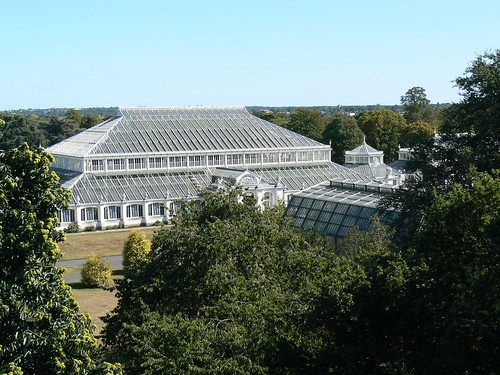
It was a while since we last visited Kew Gardens, and all else aside, we rather wanted to see the Treetop Walkway, so we decided that the end of August Bank Holiday was a good time to make the trip - the end of summer and all that. And yes, it remains a marvellous set of gardens - a place to wander all through a summer afternoon. I've put Angela's photos of the day on Flickr.

The Walkway is impressive, too - an elegant piece of engineering allowing one to take part of one's walk in the park 18 metres up, near the level of the tops of the trees. (Warning to potential visitors; the lift appears to have some kind of long-term problem. Personally, I don't find an 18 metre staircase a problem, though.) Funnily enough, this was one thing that made us consider coming back in late autumn or winter, when the leaves are down; the view it grants is currently of a lot of foliage, with just a glimpse of some buildings (including the Wembley arch). That's nice, but in a few months, it may allow some really impressive views across London. The plantings could be interesting in winter, too.

But Kew Gardens - an admirable scientific institution (currently celebrating its 250th anniversary) does feel obliged to play up the botanical education aspect. Access to the Walkway requires one to walk through an underground display centre with lots of stuff about tree biology, which is fine, but let's face it, is mostly going to be ignored by most of the visitors. It's a three-way science vs. recreation vs. commerce clash, too, when you consider the (fairly classy) gift shops clustered round the main entrances. Oh well, put it down as dynamic tension (which must be hard work).

Tuesday, August 25, 2009

Playing the Roundhouse

In a certain spirit of seeing what the fuss is about, on Monday the 24th, we made our way to The Roundhouse in Camden to look in on David Byrne's "Playing the Building" installation. For those who haven't heard, this consists of an old pump organ console, gutted and wired up to assorted noise-making arrangements around the (currently largely empty) Roundhouse building - along with a sign on the floor saying "please play". Being British, visitors queue up to tinker with the keyboard for a few minutes each, producing assorted clangs, buzzes, and whistling noises from all around the structure.

If nothing else, it was a fine excuse to appreciate the structure of the building, which is a great old bit of Victorian industrial architecture, re-purposed to good effect in the late 20th century. Byrne's installation turns it into a whistling and clattering void, but it's not so vast or so empty as to be intimidating. The circle of cast-iron pillars supporting the part-glazed roof divide and define the space, and the other visitors - of whom there were plenty when we were there, but not a crowd - create the feeling of an amiable public event.

But if part of the point of this project was the democratization of creativity, well, I think it backfired slightly. Everyone who played with the keyboard - ourselves included - had great fun, but a few places ahead of us in the queue was someone who clearly had a decent grasp of musical technique, and who, with a little thought, turned the installation into a real working instrument. (It wasn't discernibly tuned, but it had at least as much structure as a full drum kit.) This display of deftness and competence earned him a brief round of applause from other people. Apparently, there were evenings when people were invited to bring their own instruments and jam with the building; if whoever nabbed the keyboard at these was skilled enough, the effect may well have been something seriously interesting and pleasing to the ear.

*****

And then, afterwards, we wandered down into Camden, thinking to catch the tube - but, finding a bridge, we realised that we'd come to the Regents Canal, and we could stroll for half a mile along its banks to reach Regents Park. It was a reminder that London is huge, and contains much that merits visiting that I've always missed.

Theatre: The Comedy of Errors

Emmanuel College Master's Garden, 23/8/2009

Another day, another problem Shakespeare comedy. The problem in this case - the reason why this one doesn't get produced so much (I'd never seen it live before) - being of course that some people aren't sure if it's actually any good. It barely even makes it to the dictionary of quotations, after all. But the company from Shakespeare's Globe have not only tackled it; they've taken it on tour, in an authentic-practices sort of approach with a booth stage (a rectangular canvas box forming the back of the small, low temporary stage) and a cut-back cast engaging in much doubling up - albeit with costumes that mix modern dress and vaguely period-eastern-Mediterranean style (to go with some Arabic-style clarinet-based music, hookah pipes, and so on).

And hey, they had me convinced by the end that this early Shakespeare piece is worth seeing occasionally. It may be a farce that's labeled as a Comedy, but it turns out that Shakespeare could orchestrate a pretty decent farce when he wanted to (okay, borrowing hard from three different Latin sources); it's not Feydeau - a lot depends on someone who's spent several years searching for his long-lost twin brother not having the faintest idea why a town full of people might be mistaking him for someone else - but it raises quite a few laughs and has at least a touch of poignancy.

Not that this production tried too hard for the last, after an affecting opening scene. The doubling up included several major parts and both the pairs of twins who are central to the plot, which worked perfectly well until the climax, when they're finally supposed to be on stage together - and so the final scene saw life-sized cardboard cut-outs of two of the cast wheeled on to act as place-holders, while another actor, doubling the Duke and Angelo, spent a lot of time switching postures while talking to himself. The cast were slick enough to make this very funny, but it couldn't rise above the level of mock-amateur slapstick. Still, think of a touring Elizabethan theatre company, playing something originally written to entertain a bunch of drunken lawyers to a random audience of unlettered provincials, working with the resources they had available, and this was probably about right.

Mind you, on those terms, playing it in a University garden isn't strictly right - apparently, the University banned theatre companies. But on a nice day, with a picnic blanket and a production that was clever enough to make itself look convincingly rough-and-ready, who cares?

Saturday, August 22, 2009

Theatre: Measure for Measure

Cambridge Shakespeare Festival, 21/8/2009

And we finally got to catch a Cambridge Shakespeare Festival production this year, a week before the thing wound down. In Robinson College Gardens, too, which we hadn't seen properly before, and which turn out to be very nice for this sort of thing. And the weather, we earlier in the day, turned nice for the evening, if a little cool by the end...

Okay, the play. One of Shakespeare's more problematic numbers, of course, being technically a comedy but really not funny - this production did its best with the bawdy house inhabitants and other minor parts, but even that wound up being more about the flaws in humanity than about actual humour. The play ends in marriage or marriages, yes, but these are marriages as punishment. (Mind you, I do wonder if the thing worked for Elizabethan English audiences as a huge joke about Catholicism and Catholics, with their wacky un-English obsessions with sin and virginity and confession and absolution and all that. Is the Duke even a Catholic god, or at least a symbol of the Catholic church, all manipulative power and arbitrary forgiveness when it suits him?) It's a tough play to produce by Shakespeare's standards, but interesting.

I guess that the normal response these days is to see it as a story about tyranny and power, with the Duke as an arbitrary manipulator and his brother as a Puritan tyrant. This production, though, took a different line, treating the Duke as a hell of a lot less clever than he thought he was; he fumbled around attempting unsuccessful jokes and unwise tests of other people's attitudes, causing widespread unnecessary pain and really not understanding why Isabella gave him such a dirty look at the end when he tried to propose marriage to her. Angelo, meanwhile, just lacked self-knowledge, hurtling into his appalling behaviour because he didn't have a clue how people worked. Let's face it, this is a horrifically dysfunctional sort of family to have running your country on any terms; in this version, they were downright clueless. Vienna, one felt, was in as much trouble in the long term as in the short.

Technically, this was a punchy presentation, coming it at around two hours including an interval, and even losing one or two of Lucio's sharper lines that often grab the audience's sympathy. This Lucio was shaved bald and wearing white face-paint that made him look part clown, part syphilis victim, and part goblin; definitely one of the bawdy house crew, not a fallible but morally honest everyman. The quasi-comic bawdy house business also involved a leather-aproned, bare-buttocked executioner (just a small part on a cold evening, boom boom), a lot of shouting, and some weird free jazz noises from offstage that didn't help the clarity of the performance. Still, it was Shakespeare on a summer evening, as the shadows drew in and things became colder; Measure for Measure had the way of things all too well.

Saturday, August 15, 2009

Tuesday, July 28, 2009

Moon

So, D. Jones launches a promising career with a tale of alienation suffered by a solitary astronaut...

"Planet Earth is blue, and there's nothing I can do."

It is nice to see someone attempting a lightly updated stab at a '70s-style "thoughtful SF" story, complete with model-based effects rather than CGI. It's not really very hard SF, despite the early reference to He3 mining to prove that somebody has read some popular science in the last decade; the movie mostly depends on the usual middleweight SF blend of implausibly advanced handwaved technology (to drive the plot) and other technology that's barely changed since 1965 (to keep the plot on track and the special effects budget down). Moderately regular SF readers (or even viewers) will guess most of what's coming after about twenty minutes, and the film doesn't really pretend to be a mystery - the big reveal, such as it is, comes about half an hour in - but I'll be polite and not give away too much. I will just note that, for an operation that's being run on a tight-fisted budget, Lunar Industries has constructed a remarkably spacious base, and even shipped out an old leather armchair for no clear reason, and no, neither is ever explained.

For that matter, there's little or no attempt to convey the fact of lunar gravity, and no consideration of communication lags over Earth-Moon distances. But, you know - white corridors, clunky spacesuits and lunar rovers, existential angst, no guns. Heading back to 1970, in a good way, means taking the clunky with the cool. Young Jones clearly has a brain as well as useful friends; his career may be worth watching.

Expand, Contract (10)

Well, the contract for GURPS Alchemical Baroque has come back, and I gather that the manuscript is being peer-reviewed, while Kromm has passed the revised first draft of Dungeon Fantasy: Clerics, so that should also be getting some third-party consideration shortly. And I can get on to Dungeon Fantasy: Summoners.

There are some small delays with some other stuff from way back, but hopefully they'll be dealt with shortly. Not my worry just now, anyway.

Monday, July 20, 2009

Theatre: Troilus and Cressida

Shakespeare's Globe, 18/7/2009

Call me a bit middlebrow, but I really do enjoy plays at Shakespeare's Globe, definitely including their "original practices" productions. The atmosphere is unique, with a combination of intimacy and theatricality; I don't know if the designers and directors have really recreated the authentic Elizabethan format, but they certainly come up with something. But we'd not been for a while, and we left booking this until a few days before, so we had to take "restricted view" seats.

And so, after a quick early dinner at The Real Greek, just down the road (the first time we'd tried this small London-based chain - not at all bad, and eminently suited to the need of a quick bite before the play), we found ourselves up on the highest level, almost behind the stage, and looking down on the heads of the cast and squinting sideways at the musicians. Actually, though, this worked pretty well; the wraparound audience is sort of much of the point of the exercise. I wouldn't put anyone off from taking these tickets.

Now, confession time; I don't think that I've ever seen a production of Troilus and Cressida before, though I think that I read it back at school. But then, one doesn't get very many chances, and looking up the history of the play, well, one wouldn't have had any for most of the period since it was written. You can tell that this is considered minor Shakespeare; it only has a handful of resonantly oft-quoted lines.

"Time hath, my lord, a wallet at his back, Wherein he puts alms for oblivion ... Wars and lechery ... Generation of vipers ...."

Gosh, Shakespeare was in a sour mood when he wrote this one, wasn't he? Not King Lear life-is-pain, the-gods-don't-care tragic, just life-sucks-because-people-are-idiots deep-seated annoyance. I rather wonder if he'd be out drinking with a few veterans of the Dutch wars for a few nights. I do like the idea that Achilles is somewhat based on the recently-fallen Earl of Essex, who was certainly compared to the "classical" Achilles when he was at his height of accomplishment. The play's Achilles is enough of an egomaniac sociopath glory-hound to fit my impression of Essex. (I'm not sure why this version had the play's only Welsh accent, though.)

Or perhaps, not knowing the play so well, I'm being influenced too much by a modern director's interpretation. The play's contempt for the business of war-fighting has evidently made it very much a piece for the post-1914 world, and it's doubtless impossible to avoid modernising much of it. The depiction of Cressida as a desperate victim of a male-dominated, militarised world, scrabbling to survive while being treated as property, while plausible and moving, may not have been entirely original practices. But then, this production interpreted that term fairly broadly; the fairly authentic-looking Hellenic arms and armour wouldn't have been very likely in the Elizabethan era, I think. Still, the designer and armorer had some neat (if arbitrary) ideas, giving the Trojans curved kopis-style swords and bucklers, while the Greeks had straight gladius-style blades and pelta-type crescent shields. I think that the idea was to give the audience back their own vague ideas about the setting, just as would have been the norm in Shakespeare's time; along with the warriors in skirts and Hellenic helmets, there were the women in floaty white nighties, sometimes with arbitrary cutaway panels. It mostly worked, although Helen's high heels were a bit distracting. The fight scenes were a touch stylised, sometimes going into slow motion, but given the numbers involved and nature of the stage, that was probably a necessity.

Anyway... I think that I can also see why this play was tagged as a history (rather than a tragedy or a comedy), perhaps even by Shakespeare himself. Not that it fits with the rest of his history cycle, of course, but the sense that it's re-telling an existing story to make a complicated point about the subject, and letting the messy complexities of the story just lie there rather than being resolved, because that's just how they are, not wrapped up in a neat plot. (Although not being an English history, and not featuring anyone with any sort of blood relationship to the Tudors, perhaps lets Shakespeare be more cynical than the other histories normally manage.) Actually, it's a rather untidy plot; the nominal protagonists more or less disappear by the end, as the attention shifts to the death of Ajax and the war lurches on, rolling over individuals. All this open-endedness and cynicism maybe sit oddly with the somewhat carnivalesque atmosphere of a Globe production, too; the (historically authentic) closing jig ends up feeling anomalous (although I don't know how such things work when the Globe does Lear either). But one has to wonder how Shakespeare's own audience took this thing, too (this being, one gathers, even less known than for some of his other works), and I can't think of a more enjoyable way to be confronted with such questions.