Wednesday, February 12, 2014
The NHS and care.data
A matter that may be of interest to UK readers; the NHS may be trying to pull a bit of a fast one, and make the sale or release of personal patient data - not adequately anonymised - to outside organisations look like a patient care arrangement. The name "care.data" seems to be frankly misleading. See http://www.care-data.info/ for more on this, http://brief.care-data.info/ for a shorter version, or https://dl.dropboxusercontent.com/u/14156524/caredata_trifold.pdf for an explanatory leaflet, including a form for those who want to refuse permission for their data to be released.

Thursday, January 09, 2014
Expand, Contract (41)
 Suddenly, we have a positive plethora of Transhuman Space publications. David Chart's Wings of the Rising Sun (edited by yours truly) is now available from e23.
It represents, I think, a cool extension of the setting. I sold the demo game I ran at conventions using this material as "Transhuman Space meets anime, with a touch of Supermarionation", and I think that I'd stand by that. It also offers the possibility of extended campaigns where the objective is to help people, rather than the RPG-traditional picking of fights. Though you still get to pilot hypersonic ramjets down from orbit.
Wednesday, December 25, 2013
On Receiving the Ebenezer Scrooge Memorial E-Mail
We buy our gas supply through EDF Energy, because they're not self-evidently worse than any other companies in the business, and I let them e-mail me the quarterly bills, because why not? However, I was a little surprised when the latest such bill showed up this morning. Yep, on December 25th, having been transmitted the same day.
Guys, really. I'm sure that it's terribly efficient keeping your computers running 24/7, but really, Christmas Day? We have no worries on this score, but some people are tight enough for cash that bills are a genuine source of stress for them. If nothing else, a company looking this clueless in relation to PR doesn't fill one with confidence regarding their cluefulness elsewhere.
Guys, really. I'm sure that it's terribly efficient keeping your computers running 24/7, but really, Christmas Day? We have no worries on this score, but some people are tight enough for cash that bills are a genuine source of stress for them. If nothing else, a company looking this clueless in relation to PR doesn't fill one with confidence regarding their cluefulness elsewhere.
Tuesday, December 24, 2013
Expand, Contract (40)
 I nearly forgot to mention - but it merits a post; the latest issue of Pyramid magazine, #3/62, not only includes an article by myself, but is dedicated to the "Transhuman Space" setting, for which I'm line editor, so I feel a definite proprietorial affection for it.
Actually, I honestly think that it's a pretty good issue whatever. It has five substantial articles, and it's more or less designed to answer the tiresome old question of what gamers can actually do in Transhuman Space. There are five answers here; me talking about all the stuff one can run into in Port Lowell, on Mars; some character templates and ideas for a street-level game; the wherewithal for a military campaign; an idea about ultra-tech indentures, with assorted game possibilities; and a good bit of material on the world of the ultra-rich leisure class "Eloi", and what they can get up to in their copious free time.
Friday, October 18, 2013
Concert: Alison Moyet
Cambridge Corn Exchange, 16th October 2013.
I confess I hadn't been following any news or reviews before I went off to this gig, so I came to things quite fresh. To start with, I was interested to see what sort of backing band Alison Moyet would bring with her. This is, after all, a woman who moved from '80s pop to jazz standards, a stint on a musical, and even things like Purcell operatic arias (with a voice that can work with all this), trailing a range of backing musicians to suit. Well, come the time, on came ... a couple of synthesiser players, looking worryingly like the guys who come on when Bill Bailey is doing a Kraftwerk parody. Yes, the former lead singer of Yazoo had decided to revert to electronica for this tour.
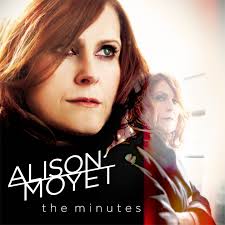 And very good they were too, actually. The two guys were actually multi-instrumentalists (and one also acted as a backing singer, often I'm pretty sure singing higher than Moyet herself), and the set was built round a really good mix of tracks from Moyet's latest album, The Minutes, and from her back catalogue. From deep in that catalogue, in fact, as she commented when pointing out that at least one of these songs was written when she was 16. I can quite believe that the lyrics of "Nobody's Diary" came from a bright, passionate teenager; if she also created that small gem of a synthesiser riff back then, she really was a prodigy.
(Alison Moyet herself was looking damn good, by the way. Apparently, she's been saying in interviews that she thinks she may have overdone the weight loss a bit, and nobody could blame her if she put a couple of pounds back on. But she sure as hell doesn't look unhealthy in a black blouse and jeans. Definitely an inspiration to her generation.)
She announced that she had been rearranging the old songs, not wanting to act as a human jukebox; some of the rearrangements were more dramatic than others - notably slowing down "Is This Love?" to a wilful extreme, and setting "Only You" (a song whose innate melancholy is a bit at odds with its poppy jauntiness) in a minor key. In general, everything worked great, and I got the impression that Moyet herself was enjoying the process. Which probably makes this the best way to handle assembling a set of songs from across a thirty-year career. Oh, and you can dance to a lot of them, too, as was probably sort of the point of putting a straightforward rendition of "Don't Go" at the end of the encores. If some of the newer songs had fewer catchy hooks than some of the early numbers, building instead on a foundation of crunching rhythm guitar, they still worked in their own way, sounding like theme tunes for a James Bond movie if Bond went a little bit gothic.
Moyet gave "Filigree", one of the key tracks from The Minutes (and a song which is loaded with gorgeous hooks), a long introduction in which she explained it was about the experience of realising that the trick is to wait for the moments when everything comes together. I think that this gig demonstrated that for me. I just hope that we might get a live album from this tour.
I confess I hadn't been following any news or reviews before I went off to this gig, so I came to things quite fresh. To start with, I was interested to see what sort of backing band Alison Moyet would bring with her. This is, after all, a woman who moved from '80s pop to jazz standards, a stint on a musical, and even things like Purcell operatic arias (with a voice that can work with all this), trailing a range of backing musicians to suit. Well, come the time, on came ... a couple of synthesiser players, looking worryingly like the guys who come on when Bill Bailey is doing a Kraftwerk parody. Yes, the former lead singer of Yazoo had decided to revert to electronica for this tour.
(Alison Moyet herself was looking damn good, by the way. Apparently, she's been saying in interviews that she thinks she may have overdone the weight loss a bit, and nobody could blame her if she put a couple of pounds back on. But she sure as hell doesn't look unhealthy in a black blouse and jeans. Definitely an inspiration to her generation.)
She announced that she had been rearranging the old songs, not wanting to act as a human jukebox; some of the rearrangements were more dramatic than others - notably slowing down "Is This Love?" to a wilful extreme, and setting "Only You" (a song whose innate melancholy is a bit at odds with its poppy jauntiness) in a minor key. In general, everything worked great, and I got the impression that Moyet herself was enjoying the process. Which probably makes this the best way to handle assembling a set of songs from across a thirty-year career. Oh, and you can dance to a lot of them, too, as was probably sort of the point of putting a straightforward rendition of "Don't Go" at the end of the encores. If some of the newer songs had fewer catchy hooks than some of the early numbers, building instead on a foundation of crunching rhythm guitar, they still worked in their own way, sounding like theme tunes for a James Bond movie if Bond went a little bit gothic.
Moyet gave "Filigree", one of the key tracks from The Minutes (and a song which is loaded with gorgeous hooks), a long introduction in which she explained it was about the experience of realising that the trick is to wait for the moments when everything comes together. I think that this gig demonstrated that for me. I just hope that we might get a live album from this tour.
Thursday, August 29, 2013
Theatre, In Brief: In the Open, Come from Verona, Twice
Just by way of a diary note for my personal records, really...
We finally got our dose of Cambridge open-air Shakespeare for the year recently, twice. On the 17th of this month, we saw the Cambridge Shakespeare Festival production of The Two Gentlemen of Verona in Robinson College gardens. I honestly don't think I've seen a live performance of this one before, and while it was fun, I guess that I can see why not. I can quite believe that this was Shakespeare's first play (as seems to be the current academic best guess); it felt like a sketch towards his later comedy career, or somebody trying to emulate a Shakespeare comedy and not getting it quite right. The production pushed for some broad comedy with the outlaws (all female in this production, presumably purely for practical casting reasons), which didn't quite come off for me. Still, even in early, weak Shakespeare, you can suddenly get a jewel like "Who is Silvia? What is she/That all our swains commend her?" dropping in.
The prototypical nature of Two Gentlemen extends to its having a character action towards the end that probably looked a bit off even when it was written, and is likely to annihilate modern audience sympathies for the character involved entirely. Talking of which... The second part of this accidental duo was The Taming of the Shrew, courtesy of the Globe Theatre company on tour, in the Master's Garden at Corpus Christi (a bit of Cambridge architecture I'd not got into before, come to think of it), on the 23rd of the month. I'd not looked at any reviews of this beforehand, so I didn't know it was going to be an all-female cast in vaguely 1920s costume. Which actually worked rather well, especially for Petruchio, who ended up as a rather dashing roaring girl type in a pilot's coat.
But the casting and costumes didn't really address the modern problem of Kate's last speech. That was handled by having her deliver it 100% straight, but then looking at the male characters' reactions, especially Petruchio's. This turned the end of that scene into a big oops, damn moment, as it seemed to dawn on him and that others that he might have gone too far there. He'd really rather liked the untamed Kate, one felt, and now he'd lost that. From then on, everyone delivered their lines hesitantly, going through the motions and giving the play a complete downer ending. Which is probably as good a solution to that issue as any.
Good music, too, by the way.
We finally got our dose of Cambridge open-air Shakespeare for the year recently, twice. On the 17th of this month, we saw the Cambridge Shakespeare Festival production of The Two Gentlemen of Verona in Robinson College gardens. I honestly don't think I've seen a live performance of this one before, and while it was fun, I guess that I can see why not. I can quite believe that this was Shakespeare's first play (as seems to be the current academic best guess); it felt like a sketch towards his later comedy career, or somebody trying to emulate a Shakespeare comedy and not getting it quite right. The production pushed for some broad comedy with the outlaws (all female in this production, presumably purely for practical casting reasons), which didn't quite come off for me. Still, even in early, weak Shakespeare, you can suddenly get a jewel like "Who is Silvia? What is she/That all our swains commend her?" dropping in.
The prototypical nature of Two Gentlemen extends to its having a character action towards the end that probably looked a bit off even when it was written, and is likely to annihilate modern audience sympathies for the character involved entirely. Talking of which... The second part of this accidental duo was The Taming of the Shrew, courtesy of the Globe Theatre company on tour, in the Master's Garden at Corpus Christi (a bit of Cambridge architecture I'd not got into before, come to think of it), on the 23rd of the month. I'd not looked at any reviews of this beforehand, so I didn't know it was going to be an all-female cast in vaguely 1920s costume. Which actually worked rather well, especially for Petruchio, who ended up as a rather dashing roaring girl type in a pilot's coat.
But the casting and costumes didn't really address the modern problem of Kate's last speech. That was handled by having her deliver it 100% straight, but then looking at the male characters' reactions, especially Petruchio's. This turned the end of that scene into a big oops, damn moment, as it seemed to dawn on him and that others that he might have gone too far there. He'd really rather liked the untamed Kate, one felt, and now he'd lost that. From then on, everyone delivered their lines hesitantly, going through the motions and giving the play a complete downer ending. Which is probably as good a solution to that issue as any.
Good music, too, by the way.
Monday, August 12, 2013
Expand, Contract (39)
 Some time back in the mid '90s - I've lost track exactly when, and my records don't extend quite that far back, but it would have been around 1995-6 - Atlas Games were publishing material for Hero Games's Champions RPG under license, and I sold them on the idea of a scenario book called The Sands of Time. I put a manuscript together and off it went ... and after a little while, the project fell victim to the collectible card game-powered chaos of the period, as that license deal faded out.
It happens. It's wouldn't have been the only project in my history to have died on me after too much work had been done. However, this one happened to have been assigned an editor, Spike Jones, who not only stayed in the business, but kept getting Champions-related editing jobs, and kept faith in the book, and sometimes brought it to the attention of other companies for whom he was doing work. Well, it didn't cost me any significant extra work.
Hence, in late 1997, the project was with Gold Rush Games, and was being reworked into their San Angelo setting/world. In fact, by 1999 it was edited and heading for layout - if only they could find someone with the time to do that job. It was supposed to be published in 2001, but then Gold Rush sold the rights to San Angelo to Hero Games. Sands should have gone with that ... but in 2002, the rights to San Angelo stuff went back to Gold Rush Games, who ended up using the setting with a completely different rule-set, and Sands fell through the cracks again.
So I was pleasantly surprised in 2010 when I heard from Blackwyrm Games that Spike had been talking to them. Of course, by then, the Champions rules were two full editions on from where they'd been when I wrote Sands, but they were prepared to get somebody else to do something about that - and for that matter, about updating the geopolitical background details. But that took a while...
Getting on for three years, in fact. But The Sands of Time is now, actually out - at least seventeen years after I wrote it. I don't know if that's any sort of industry record - I doubt it - but, well, there may be gamers who'll buy and run it who weren't even born when I wrote it. And it's certainly a personal record. Anyway, thanks and congratulations to Blackwyrm for finally getting this out the door.
Now we just have to sell it.
(Footnote to this: digging through my computer files, I realise that the date stamps on my first draft word processor files for this book go back to 1994, or in some cases late 1993. So it didn't quite make twenty years from first draft to print, but darned close. Come to think of it, I'm not sure that the scenario wasn't originally written for Hero Games, before being offered to Atlas...)
Sunday, June 16, 2013
Much Ado About ... Murder
There's a problem with trying to play Much Ado About Nothing in modern dress; these just aren't quite modern people in a modern world. They can seem that way for long stretches, but then - Beatrice snaps, spits, or whispers "Kill Claudio", and it all goes a little strange. The standard solution, by my casual observation, seems to be to set it no later than the Edwardian period - the last time that the combination of an honour culture and assumed aristocratic privilege makes this sort of thing, along with warfare as an extension of family squabbles, reasonably plausible.
 Joss Whedon's cheerfully hastily assembled black-and-white movie treatment tackles such problems largely by ignoring them, bulling straight through the script as a reading by some people who happen to be highly competent actors in modern dress. Where modern equivalences can be found for details in the story, they're used; where they can't, never mind. There are occasional oddities; Beatrice and Benedick get a modern-style sexual history, whereas Hero and Claudio preserve their proper sense and assumptions of virginal purity - but even that can be seen as setting up a contrast between the worldly (and mutually suited) lead couple and the more idealistic (and flawed) secondary pairing.
However, there are hints of a darker modernity. These people in smart suits and big limos, fighting killing wars with their own family? The local cops, a bunch of bumbling dolts totally under the thumbs of the patronising rich folk? The reverence for Catholicism, in the person of a smoothly obliging priest? The improvised cable tie handcuffs and polished personal handguns? You know, it's just possible that these characters are actually a bunch of Mafiosi. They're terribly polite about it, of course - they wouldn't dream of talking business in front of the womenfolk (apart from Conrade, who's been sex-changed into a cold-eyed moll and honorary guy) - but the story ends up with a chilly edge if you look at it this way. The problem isn't that anyone contemplates killing anyone else, it's that they do so when everyone was supposed to be kicking back and taking a break from business.
(Like Whedon was, actually...)
But that's just a possibility; Whedon hasn't touched Shakespeare's words, so we just have to fit our assumptions to what ends up on the screen. And it's not like the analogy doesn't work quite well with Elizabethan aristocrats.
Amy Acker gives great Beatrice, by the way - more unhappy and betrayed than aggressive or dangerous, but well able to handle slapstick, love scenes, vengefulness, and Shakespearean prose. She's already got a decent TV career, but one suspects that a few big-movie casting directors will be calling her agent after this one.
Joss Whedon's cheerfully hastily assembled black-and-white movie treatment tackles such problems largely by ignoring them, bulling straight through the script as a reading by some people who happen to be highly competent actors in modern dress. Where modern equivalences can be found for details in the story, they're used; where they can't, never mind. There are occasional oddities; Beatrice and Benedick get a modern-style sexual history, whereas Hero and Claudio preserve their proper sense and assumptions of virginal purity - but even that can be seen as setting up a contrast between the worldly (and mutually suited) lead couple and the more idealistic (and flawed) secondary pairing.However, there are hints of a darker modernity. These people in smart suits and big limos, fighting killing wars with their own family? The local cops, a bunch of bumbling dolts totally under the thumbs of the patronising rich folk? The reverence for Catholicism, in the person of a smoothly obliging priest? The improvised cable tie handcuffs and polished personal handguns? You know, it's just possible that these characters are actually a bunch of Mafiosi. They're terribly polite about it, of course - they wouldn't dream of talking business in front of the womenfolk (apart from Conrade, who's been sex-changed into a cold-eyed moll and honorary guy) - but the story ends up with a chilly edge if you look at it this way. The problem isn't that anyone contemplates killing anyone else, it's that they do so when everyone was supposed to be kicking back and taking a break from business.
(Like Whedon was, actually...)
But that's just a possibility; Whedon hasn't touched Shakespeare's words, so we just have to fit our assumptions to what ends up on the screen. And it's not like the analogy doesn't work quite well with Elizabethan aristocrats.
Amy Acker gives great Beatrice, by the way - more unhappy and betrayed than aggressive or dangerous, but well able to handle slapstick, love scenes, vengefulness, and Shakespearean prose. She's already got a decent TV career, but one suspects that a few big-movie casting directors will be calling her agent after this one.
Thursday, January 03, 2013
Over the Break...
Christmas and the New Year were mostly spent at home (and with the weather lately, with no regrets at that), but we did get out for a couple of things.
 One was Mughal India: Art, Culture and Empire at the British Library. Hmm - I remember when the British Library was this thing buried behind the immediately-visible scenes at the British Museum. Then, for a while after they moved to Kings Cross, they seemed to do just little exhibitions about language and bibliography. This, though, had the look of a major museum exhibition. Actually, though, it did mainly lean on stuff from the Library's own collections - a few maps and letters and so on and a lot of gorgeous illustrated texts. The Mughals had that fondness for micro-detailed art - one assumes that a lot of anonymous artists with one-haired brushes ruined their eyesight to bring us this beauty. Just digging some of those pages out from the stacks and putting them on show certainly justified this event. Still, the curators had also borrowed a suit of mail from the Royal Armouries and some swords and plaques and sculptures from elsewhere, giving things a slightly more three-dimensional quality, and it was all presented nicely. Worth the trip.
Oh, and we also got to Kew Gardens. We'd been meaning to have a look at the place in winter for a while. One reason was the treetop walkway; we were somewhat curious to see what the view would be like with the leaves off the trees. The answer there turned out to be "not without interest, but not that much different either"; there are enough evergreens and densely-branched deciduous growth to obstruct views a bit, and there was no clear view through to much of London. On the other hand, well, the conservatories are always fascinating and of course mostly disregard the weather outside; I'm pretty sure that the Princess of Wales Conservatory had more open and on show than last time I was there, and there were some aquariums in the basement of another building that I don't recall seeing before. Oh, and there were some sculptures on exhibition, too.
So that was another good day out. And we didn't even get rained on very much.
Oh, and we also got to Kew Gardens. We'd been meaning to have a look at the place in winter for a while. One reason was the treetop walkway; we were somewhat curious to see what the view would be like with the leaves off the trees. The answer there turned out to be "not without interest, but not that much different either"; there are enough evergreens and densely-branched deciduous growth to obstruct views a bit, and there was no clear view through to much of London. On the other hand, well, the conservatories are always fascinating and of course mostly disregard the weather outside; I'm pretty sure that the Princess of Wales Conservatory had more open and on show than last time I was there, and there were some aquariums in the basement of another building that I don't recall seeing before. Oh, and there were some sculptures on exhibition, too.
So that was another good day out. And we didn't even get rained on very much.
Tuesday, December 25, 2012
Christmas Catch-Up
It seems that I haven't posted here much lately, doesn't it? I hope that nobody has been missing me.
Some time around the middle of the year, I got a bit busy for a short while, and then I didn't have a huge amount that really seemed worth saying, and then I just got out of the habit. Or maybe I just lost interest. Well, for the record, it's not that my life has been completely empty in that time. Aside from a few conventions and such, I've even managed another holiday.
 At the end of November, Angela and I spent a week in and around La Orotava, in northern Tenerife. This might seem a strange time of year to head out that way, but hey, it's warmer there than here. We did end up getting rained on a bit, but we also got up a three-and-a-half-kilometre volcano to look down on a Dr Who gravel pit set the size of a county, saw surfers hitting a beach of black sand, and ate a bit of sea food. However, I seem to be recording that sort of thing more in photographic than in written form at the moment; I'm still updating my Flickr account with photos from the trip, but those pictures are all going into a collection there. Oh, and I'll thoroughly recommend the Hotel Alhambra, where we stayed.
Anyway, I may try to update this blog a little bit more often again from now on. It does depend on inspiration and energy, though, I fear. In the meantime, Seasonal Best Wishes to anyone who reads this in time.
Some time around the middle of the year, I got a bit busy for a short while, and then I didn't have a huge amount that really seemed worth saying, and then I just got out of the habit. Or maybe I just lost interest. Well, for the record, it's not that my life has been completely empty in that time. Aside from a few conventions and such, I've even managed another holiday.
At the end of November, Angela and I spent a week in and around La Orotava, in northern Tenerife. This might seem a strange time of year to head out that way, but hey, it's warmer there than here. We did end up getting rained on a bit, but we also got up a three-and-a-half-kilometre volcano to look down on a Dr Who gravel pit set the size of a county, saw surfers hitting a beach of black sand, and ate a bit of sea food. However, I seem to be recording that sort of thing more in photographic than in written form at the moment; I'm still updating my Flickr account with photos from the trip, but those pictures are all going into a collection there. Oh, and I'll thoroughly recommend the Hotel Alhambra, where we stayed. Anyway, I may try to update this blog a little bit more often again from now on. It does depend on inspiration and energy, though, I fear. In the meantime, Seasonal Best Wishes to anyone who reads this in time.
Friday, July 13, 2012
The Arts of Empires
Stuff gets left over from the past. And then we suddenly realise that it might be worth remembering, and we find ourselves scrabbling a bit, trying to reconstruct things, put our own interpretations on them, decide what was or wasn't significant.
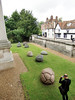 I've neglected to blog about the 22nd of last month, until now. It was a moderately busy day, and I've fairly recently finished putting a bunch of photos from then up on Flickr. But actually, those only cover an early part of the day.
Specifically, we made a round trip to Cambridge to catch a couple of things, starting with a visit to the Fitzwilliam Museum, where for one thing, this year's Sculpture Promenade is in full swing. That was the point when I managed to capture a decent array of pictures. As in previous years, it proved amiably brain-stretching; we were mildly amused to run into a miniature prototype for the monumental Peter Randall-Page piece that we met at the Eden Project a while back.
But we had gone to the museum chiefly to catch something that isn't likely to come back often in our lifetimes; an exhibition of 2,000-year-old tomb treasures from China, loaned from two different Chinese museums - so to see all this lot would normally require a long round trip. There was ... a lot of jade, naturally, including two of the famous jade burial suits - not so much jade armour as full-body casings, the product of imperial wealth and the belief that jade preserved the body against corruption. There were also great bronze vessels and domestic bits and pieces, which had (just) survived two millennia of burial. But I guess that the things that spoke most effectively, as art, were rather inevitably the fairly small statuettes, figures from courtly life - especially some swirling dancers, their infeasibly long sleeves falling to the floor oddly like cartoons.
But a piece of art doesn't have to be twenty centuries old to be a period piece. That evening, we had tickets for Noel Coward's Volcano at the Arts Theatre, a relic of an earlier era, but not without amusement value. Actually, this play wasn't produced in Coward's own lifetime, initially because it proved impossible to get Katharine Hepburn on board to play the lead, but probably mostly because the sexual - and especially homosexual - content was a bit heavy for the period. It hasn't had much attention since, either; this is apparently its first-ever major production, complete with Jenny Seagrove gamely tackling the Hepburn maturely-repressed-sexy role. (No other cast members whose names I recognised, I'm afraid; I mostly ended up thinking that a Noel Coward play probably has to feature actresses with names like Finty Williams and Perdita Avery.) I can't say that it struck me as a major work of art, and it's probably not one of Coward's greatest pieces, but I laughed a bit, thought a very little, and reckoned that the staging was pretty good.
The sexual content was clear enough, incidentally, but obviously no big deal by modern standards. I suspect that it took a bit of effort from the director and cast to make the gay element even clearly noticeable, and it represented a rather small twist late in the plot even then. It was hard to avoid feeling that the volcanic eruption - however well staged - ended up as a bad case of the pathetic fallacy being used for emphasis.
But it was something to be seen. Still, it was the Chinese antiquities that were something not to be missed.
I've neglected to blog about the 22nd of last month, until now. It was a moderately busy day, and I've fairly recently finished putting a bunch of photos from then up on Flickr. But actually, those only cover an early part of the day.Specifically, we made a round trip to Cambridge to catch a couple of things, starting with a visit to the Fitzwilliam Museum, where for one thing, this year's Sculpture Promenade is in full swing. That was the point when I managed to capture a decent array of pictures. As in previous years, it proved amiably brain-stretching; we were mildly amused to run into a miniature prototype for the monumental Peter Randall-Page piece that we met at the Eden Project a while back.
But we had gone to the museum chiefly to catch something that isn't likely to come back often in our lifetimes; an exhibition of 2,000-year-old tomb treasures from China, loaned from two different Chinese museums - so to see all this lot would normally require a long round trip. There was ... a lot of jade, naturally, including two of the famous jade burial suits - not so much jade armour as full-body casings, the product of imperial wealth and the belief that jade preserved the body against corruption. There were also great bronze vessels and domestic bits and pieces, which had (just) survived two millennia of burial. But I guess that the things that spoke most effectively, as art, were rather inevitably the fairly small statuettes, figures from courtly life - especially some swirling dancers, their infeasibly long sleeves falling to the floor oddly like cartoons.
But a piece of art doesn't have to be twenty centuries old to be a period piece. That evening, we had tickets for Noel Coward's Volcano at the Arts Theatre, a relic of an earlier era, but not without amusement value. Actually, this play wasn't produced in Coward's own lifetime, initially because it proved impossible to get Katharine Hepburn on board to play the lead, but probably mostly because the sexual - and especially homosexual - content was a bit heavy for the period. It hasn't had much attention since, either; this is apparently its first-ever major production, complete with Jenny Seagrove gamely tackling the Hepburn maturely-repressed-sexy role. (No other cast members whose names I recognised, I'm afraid; I mostly ended up thinking that a Noel Coward play probably has to feature actresses with names like Finty Williams and Perdita Avery.) I can't say that it struck me as a major work of art, and it's probably not one of Coward's greatest pieces, but I laughed a bit, thought a very little, and reckoned that the staging was pretty good.
The sexual content was clear enough, incidentally, but obviously no big deal by modern standards. I suspect that it took a bit of effort from the director and cast to make the gay element even clearly noticeable, and it represented a rather small twist late in the plot even then. It was hard to avoid feeling that the volcanic eruption - however well staged - ended up as a bad case of the pathetic fallacy being used for emphasis.
But it was something to be seen. Still, it was the Chinese antiquities that were something not to be missed.
Friday, June 29, 2012
Views from the North
 It's a peculiar thing that, in many years of holidays first with family and later not, I'd never actually made it to the English Lake District. Angela had, but it was a long time ago, and some of her photographs back then had accidents when being developed. So, in mid-May, we spent just over a week rectifying those omissions. I've just finished putting the better photographs we took on that trip up on my Flickr account.
 Unfortunately, we didn't pick the one week in May when the weather was actually passable, but we weren't there to walk long distances, and we were working on the principle that it's the Lake District; if you don't get rained on a bit, you're doing something wrong.
And my general conclusion; it's actually an advantage while up there not to be a particular devotee of the Romantic poets (or John Ruskin). It lets you take the area as it comes, admiring some superb scenery and general picturesque-ness as you stumble across it without feeling obliged to drag round a lot of peculiar little cottages or play spot-the-daffodil.
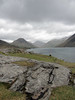 (Though we did accidentally encounter the spot where Dorothy Wordsworth found a lot of nice daffodils, before her brother nicked her diary entry and put it in verse. We weren't there in daffodil season, though.) Also, Wasdale does the "magnificently bleak" thing superbly, and has a good pub at the far end.
Friday, June 01, 2012
Expand, Contract (38)
As something of an inevitable sequel to the immediately preceding post - e23 has now followed up GURPS Castle Falkenstein
with my own GURPS Castle Falkenstein: The Ottoman Empire, which by the way is dual-statted for GURPS and the original Castle Falkenstein rules.
 Like most Falkenstein game material, this book entangles a fair amount of authentic 19th century history with a lot of rather gonzo steampunk high fantasy. The difference is that I was working with the history of the last years of the Ottoman Empire, which got rather gonzo in its own right, by most rational standards, as well as being as depressing as a lot of history when you look closely. Ottoman Turkey really was an archetypal totally screwed-up ancient empire on the slide. That makes it an interesting place to visit, but you really wouldn't want to live there.
The book itself is almost interesting in its way, because it follows the original Castle Falkenstein standard presentation style of including a lot of first-person setting fiction. (That's not Steve Jackson Games' house style, but the book was originally written for R.Talsorian. The Designer's Notes explain.) Come to think of it, Ottoman Empire may represent the single largest work of fiction which I've ever had published, interwoven with the games stuff. Which is probably either cool or sad. Very possibly both.
I did have some fun deciding what to put into the "Cinema" section of the bibliography, I must admit.
Tuesday, May 22, 2012
Expand, Contract (37)

GURPS Castle Falkenstein was a little unexpected in this context because it's about a licensed third-party setting, and the company needs to renegotiate things with the IP owner to get those books re-released as PDFs. However, it may be less surprising that the company managed to negotiate an expansion to this license than would be the case with many; unlike, say, Conan (not one of mine, but one which recently made a similar, more surprising GURPS/e23 reappearance), Falkenstein was licensed from another games publisher, who'll have a realistic view of the possibilities, and who won't have many other uses in mind for the IP.
Anyway, it's a book in which I take a little pride, and it's a chunky volume with some nice art. (I should also point out that it was a collaborative effort - the one book I've done with the admirable Jim Cambias.) So I'm happy to see it out there once again.
Wednesday, May 09, 2012
Marvel Avengers Assemble
 (Yes, that's what it's officially called in the UK.)
One newspaper reviewer referred to this as a Greatest Hits compilation of all the preceding Marvel movies from the same studio, which is a little unfair to the film, but not entirely unfair to the Avengers the comic-book hero team, whose only reason for existing is really to be a bunch of popular characters, all together! The Fantastic Four are a family; the X-Men are a shared experience of prejudice, but the Avengers are ... Earth's Mightiest Heroes. Except when the rotating membership list takes the mightiest ones out and cycles some second-stringers in.
But the movie, starting fresh, was able to include a goodly collection of mighty fan favourites, while quietly avoiding the comics-founder-member but probably-nigh-unfilmable (on grounds of silliness) Ant Man and Wasp. Then it added Hawkeye, to up the human-identification and cool-gadgets factors, and Black Widow, to provide eye candy and avoid, as Joss Whedon apparently had to point out to the studio, having the whole thing look like a gay cruise. I'm not sure that Scarlett Johansson in a black catsuit lowered the testosterone level of the movie very far, but she probably ensured that Whedon could be brought aboard, which was the important thing.
("Yes, okay Joss, you can reenact the Buffy-Angel thing with Black Widow and Hawkeye.")
Because, if we're going to have compendiums of good bits and character grace notes and cliches from other movies, some in completely different genres, some of them cliches so new that Michael Bay has barely finished inventing them, then this the way it should be done. Whedon seems to be the Hollywood-acceptable name best suited to constructing these superlatively choreographed action scenes and intervening character angst-fests. Heck, he even manages to construct a justification of sorts for the team name, which is more than Marvel have ever managed in fifty years of publishing the title. (The fact that personal vengeance, while much beloved of Hollywood and Hong Kong action movies, is a rather sleazy motive for heroes, is neither here nor there.) And there's little arguing with the audience numbers, which say that we are going to get more of this sort of thing, whatever.
Meanwhile, Tom Hiddleston, basically unknown in Hollywood before Kenneth Branagh spotted his potential for Thor, makes sure of his options for a very profitable secondary career playing Hollywood villains with English accents. In this movie, Loki gets to engage in more spring-heeled physical violence than I ever remember him bothering with in the comics - where he's a generic smug super-mage - and more blue-eyed spitting villainy, and Hiddleston strolls it. Whatever happens with Marvel comics-based movies, I think that we have a worthy successor to Alan Rickman. Which I guess is a win.
Monday, April 30, 2012
Heading West (and Taking Pictures)
 I recently finished putting the photos from a weekend down in south-west England up on my Flickr photostream. A moderately frenetic two days, that - we got as far as Cornwall, without Angela having to take any time off work - but fun.
To start with, it gave Angela an excuse to try a return visit to the Methuen Arms, in Corsham, which once upon a time was legendary among her colleagues as a place you booked to stay on business once, so you'd know not to go there again. Suffice to say that it's changed hands since then, and been changed completely, and now it's a very nice place to spend a Friday night, with a good restaurant and all. However, that was just a first-night stopping place, as the next day, the 24th of March, we were on the road again for a few hours.


 The primary destination for the day was the Lost Gardens of Heligan, which we hadn't managed to fit into previous trips down west in recent seasons. For those who don't know of them, these are the gardens of a rather grand country house which fell into total decline and decay in the latter part of the 20th century, until they were rediscovered a few years ago by someone who has managed an extraordinary feat of horticultural resurrection.Nonetheless, and despite being quite rightly full of enthusiastic visitors, they still have a slightly wild feeling in places - one part is quite plausibly known as "The Jungle" - while having been restored to enclosed formality in other parts. A good place to see, even if you're not especially fascinated by gardens as such; there's a definite feeling of an old-time private estate, with everything from Italianate formality to woodland walks, poking through a thin layer of time. Plus some fairly weird sculptures.
 We'd hoped to follow this up with a quick visit to the nearby Eden Project - we still had tickets from our visit last year which are good for twelve months, darn it! - but unfortunately, that was still on its winter opening schedule, and was closed by the time that we got there. So we rolled on, diverting a short distance for a brief visit to the real Jamaica Inn (just looking round the outside, really), before driving on to spend the night in Okehampton.
 The next day (the 25th of March), we were heading back eastwards - but with a stop planned. We'd seen flyers for the Haynes International Motor Museum, and we thought it sounded interesting. We were right. I suspect that this is the biggest motor museum collection in the country, lurking in a giant shed or two in Somerset, and it probably deserves to be better known. It's currently undergoing a bit of refurbishment and expansion work, but even so, it combined aesthetically impressive experiences (some fabulous designs from multiple eras) with twinges of sometimes downright painful nostalgia (several iffy 1970s models that I thought were really cool in my early teens). Probably only a motor museum can do this quite so effectively.
 (A note on the name and origins of this museum, mostly for the benefit of non-UK residents; the Haynes motor manuals are a very useful line of independently-published workshop manuals. The chap who founded the company was evidently a serious car enthusiast, and his collection formed the core of this collection.)
 Among the aesthetic positives, by the way, was a real, honest-to-God 1931 Duesenberg. We stumbled across this early in the tour, although I think it's meant to be a bit of a climax for a visit, because the current building work means that visitors end up going round the place in the reverse of the usual direction. This name may not mean very much to Europeans reading this; it wouldn't have meant very much to me before this trip. But let's just say that this thing is unique in Europe, one of eight of its kind in the world - and if you were drawing a comic strip set in the 1930s USA, and you wanted to show that some rich or powerful character had some degree of taste or style, this is the car which he'd arrive in. It's an authentic work of art.
 Anyway, having finished there, we were able to get home in reasonable time, even stopping briefly on the way to take a quick look at Stonehenge over the surrounding fence. So I ended up with a lot of photos.
Sunday, April 22, 2012
The Pirates! In an Adventure with Scientists!

Anyway, being an Aardman movie, this is definitely enough fun to catch in the cinema, although you may also want to purchase the DVD, not for the Primer reason of having to work out what the hell was going on, but for the simple pleasure of freezing every frame to catch all the little visual jokes that the makers overdo at every opportunity. Whether there's more to it than that may be an open question. It is very silly, and laden with anachronisms of all sorts, mostly no doubt derived from its source material in children's fiction.
Like a lot of pirate movies, it has small pretensions to be about the end of an age of romance in the face of the onset of the modern industrial world - here symbolised by the contrast between the pirates' ship (a proper pocket galleon) and Queen Victoria's yacht (a rather magnificent steampunk creation incorporating the domes from the Royal Pavilion). But that doesn't really fly; the heroes' secondary foes are pirates who are even more old-school than themselves, they ally with Charles Darwin, and they make good use of an airship.
As I said, it's fun. I'm not sure that it's quite up there with Nick Park's best work for the company - perhaps the anachronisms, or the touches of outright visual surrealism, or the slightly plonking use of familiar songs on the soundtrack, jarred with me too much - but it had some good jokes and excellent visuals, and the celebrity voice cast were used well without dominating things too much. Clay and CGI are quite deftly merged, too. Just don't ask me what the ham obsession is all about.
Tuesday, April 03, 2012
The Uses of Marinades
Marking a birthday yesterday, I was in London for the afternoon. Working on the principle that a birthday demands some small new experience, I decided to try a Peruvian restaurant I'd recently read about; Ceviche, on Frith Street. Turned out to be a good move. Yes, I tried some Peruvian ceviche (raw sea bass, lime, chilli, coriander, toasted corn as a garnish); I also think I (knowingly) ate beef heart for the first time in my life - I'd assume that it could normally be rather tough, but sliced quite thin, marinaded in chilli, then grilled on wooden skewers, it was simply toothsome.
The chocolate mousse claimed to come with "guanaban (soursop tropical fruit)" cream. Umm, seemed like pleasant whipped cream to me. Maybe my palate had been a little too well blatted with lime and chilli. However, it was an excellent chocolate mousse. The coffee didn't mess about, either.
I definitely have the place down for a return visit or two. It's one of those "share lots of small plates" set-ups, and I need to try a few more of the options.
The chocolate mousse claimed to come with "guanaban (soursop tropical fruit)" cream. Umm, seemed like pleasant whipped cream to me. Maybe my palate had been a little too well blatted with lime and chilli. However, it was an excellent chocolate mousse. The coffee didn't mess about, either.
I definitely have the place down for a return visit or two. It's one of those "share lots of small plates" set-ups, and I need to try a few more of the options.
Tuesday, March 27, 2012
And ... Home (Views Over Asia)
So now - at last - all the photos from our three-week, thirtieth-anniversary holiday of last October are up on my Flickr photostream.
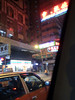 The last day of the trip - an extended version of the 29th of the month - involved a 4am start (which is no great fun), a drive through the small-hours but nonetheless well-illuminated streets of Hong Kong, and the discovery that even Hong Kong airport doesn't really get moving that early. It took a little while for the catering to open up, but eventually we managed to find breakfast, and decided to try some local paper-wrapped rice-based thing.
Hmm. Possibly an experiment too far. Let's just assume that it's a taste which locals acquire from childhood, shall we?
 So we boarded our Qantas 747, and spent the next few hours largely on a route that Marco Polo might, I guess, have regarded as familiar (assuming, modern theories notwithstanding, that he didn't just make stuff up), just a few miles higher up, in much greater comfort, and with some watching of movies and TV on the back of the seat in front. Were those the Tian Shan mountains down there, and if so, where was Shangri-La? And was that the Taklamakan desert? Not sure, but anyway, does flying over count as going in?
Ah well, those are not modern concerns. Modern concerns are things like Qantas grounding their entire fleet for a few days due to a large-scale row with their air crew union, which we only later discovered happened while we were in the air. Hmm. Dodged a last-minute problem there.
Which brings me ... back to where I was months ago.
Hmm. Possibly an experiment too far. Let's just assume that it's a taste which locals acquire from childhood, shall we?
So we boarded our Qantas 747, and spent the next few hours largely on a route that Marco Polo might, I guess, have regarded as familiar (assuming, modern theories notwithstanding, that he didn't just make stuff up), just a few miles higher up, in much greater comfort, and with some watching of movies and TV on the back of the seat in front. Were those the Tian Shan mountains down there, and if so, where was Shangri-La? And was that the Taklamakan desert? Not sure, but anyway, does flying over count as going in?Ah well, those are not modern concerns. Modern concerns are things like Qantas grounding their entire fleet for a few days due to a large-scale row with their air crew union, which we only later discovered happened while we were in the air. Hmm. Dodged a last-minute problem there.
Which brings me ... back to where I was months ago.
Monday, March 26, 2012
Views of Hong Kong
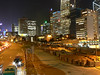
 The photos from our big holiday last year are nearly all up now; I've just finished putting up the biggest day's worth of all; the 28th of October. That was the one full day we had in Hong Kong. Fortunately, we had planned to cram a fair amount into that time.
Still, it was just one day, so it's probably stupid of me to draw conclusions about the city. On the other hand, this is my blog.
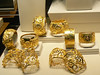 What I almost said is that Hong Kong is extraordinary. But that's just not true, really. In a very important way, it's the most ordinary place on Earth. (Except perhaps in the small matter of scale.) Human beings have been building cities for the last five or six thousand years, I guess, and Hong Kong seems to me to be the modern quintessence of the city. It's not actually the biggest, it's certainly not the most beautiful, but it does the thing that cities have done for almost all that time, but which cities in the West have largely given up doing - and it does it much better than most of the developing world mega-cities. That thing is partly make money, or perhaps just make some people rich, but even more important is being seen to make people rich. Which is why Hong Kong - bustling, plutocratic, adaptive - is still sucking population out of its rural hinterland (relatively backward, almost feudal) at a formidable rate - the ancient power of the promise of The Big City. However, as modern Hong Kong has modern medicine and sanitation, it doesn't kill those immigrants or its own children especially fast, unlike most cities in history (although it's managed slightly more in the way of plague in recent years than most developed-world cities), so it grows instead. And the smart and the lucky get rich, and flaunt their wealth, and buy showy gold ornamentation - gold stuff that would barely look out of places if it emerged from a Sumerian archaeological site.
 Anyway - in the morning, of our day, we had a coach tour planned. So after breakfast in the hotel's previously-mentioned multi-ethnic buffet restaurant, we grabbed a taxi to the starting point, got ourselves onto the right coach, and set off. The coach promptly headed out of town past a couple of minor landmarks, and took us away from the urban parts of Hong Kong Island and into the rather greener south. This is an area with a fair amount of, essentially, very expensive suburban development, but it also encompasses places like Aberdeen Harbour, our first stop. This is a working harbour and home to a fishing fleet, but it's also a tourist destination with a giant floating restaurant, and a location for scenes in James Bond movies and the like. Also, according to the guy on whose boat we took a brief tour of the harbour, one of the big yachts we saw moored there belongs to Jackie Chan, and the big house overlooking the harbour is also his, so I guess the place has multiple sightseeing options covered.
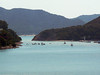 Then we were back on the coach and along the coast, past Repulse Bay (evidently a serious plutocrat playground) to Stanley, which would pass as a pleasant small seaside resort in Britain, apart from the thing for which it seems to be most noted; Stanley Market, a mass of stalls selling a lot of the sort of stuff that people come to Hong Kong to buy (silks, souvenirs, and so forth). However, we weren't shopping much, so we found a local restaurant and grabbed an early lunch of dim sum.
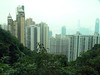 And then we rolled back over the hills at the centre of the island, admiring some views on the way, to catch what was probably the most dramatic view of all - the one from Victoria Peak, above the city. (Okay, I also managed to find a green tea and date ice cream there. I could get used to that stuff.) Readers will note that we took a fair number of pictures. The other thing about the Peak - apart from its status as an up-market residential and recreational area - is that access to and from the centre of the city below can be by a specialised tram, and we rode that down, passing the upper floors of skyscrapers as we went, to meet our coach and return to our starting point.
 Which basically gave us the afternoon and evening to explore the city for ourselves on foot. To start with, we found ourselves in Times Square. (Yes, that's what it's called. Hong Kong displays an unlimited willingness to nick ideas from other cities if they seem saleable.) We then wanted to make our way from there to the waterfront, so we looked at a map and set off in the right direction. And within yards, we were out of the realm of shiny skyscrapers and expensive shops, and in a bustling street of grocers and fishmongers, the latter of whose wares were so fresh that they were often still flapping around.
This brought home to us something that we'd already begun to register on the shuttle from the airport the night before; Hong Kong really doesn't seem to have "neighbourhoods" in the sense that those of us used to Western cities think of the word. We were staying in a moderately swish hotel, and had cause to pass even fancier places - and yet, within a few yards of the door, one could be passing shabby cafes and very ordinary residential blocks. We didn't encounter anything that felt threatening, but the shifts in urban atmosphere over a few paces could be startling. It seems that, when something is needed in Hong Kong, it gets put where there's a space, regardless of what else may be around - and presumably the land prices are just high everywhere.

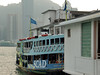 Anyway, we found the waterfront, and most importantly, something that had rightly been recommended to us. A ride on the ferry between Hong Kong Island and Kowloon, on the mainland, costs about 20p per person, and may be the best tourist trip for that money anywhere on Earth. Hong Kong sprawls along both sides of the straits that it uses as a harbour, and looks pretty good in late afternoon light. (Actually, I suspect that it looks good from that viewpoint in most lights.) And so it was that we came back to the mainland of Asia. Gawping a little, in my case, perhaps.
(Other observations when looking round Hong Kong harbour areas; well, a "typhoon shelter" turns out to be a bit less dramatic than the term makes it sound. Basically, it's a bit of harbour that's reasonably sheltered from bad weather.)

 The area where the ferry docked had a few tourist sights of its own close to hand. To start with, there's a clock tower, which is actually all that's left of the old Kowloon-Canton Railway Terminus of colonial times. Then there's the old Marine Police Headquarters, now a luxury hotel; this used to be perched on a small hill, but that's now been dug away to accommodate a shopping centre. Then, heading back to the waterfront, we took a stroll along the Avenue of Stars.
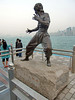 I mentioned that Hong Kong happily pinches ideas from other cities, didn't I? Well, it pinched this one from Hollywood, obviously. Yep, hand-prints of famous Hong King movie stars in cement, plus a couple of only-slightly-tacky statues.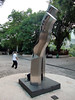
 Working back round from there, we hit Nathan Road, Kowloon's big shopping street (with jewellers selling some of the previously-mentioned gold), before getting up as far as Kowloon Park. That was a bit of an accidental discovery, to be honest, but worth the time, with not only a range of greenery but a sculpture walk and a pool which serves as the home for a range of bird species, including a flock of flamingos.
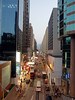 After which, we crossed a major road by a footbridge and had a brief look at the glittering skyscrapers of a modern waterfront development. (Okay, yes, another one.) By this time, dusk was falling, so with some difficulty, we found our way down to street level through a slightly maze-like covered shopping area, and wandered back down to the ferry terminal.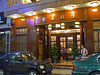
 Another trip across the harbour later, we were looking for dinner on the evening streets of Hong Kong. The guidebook pointed us at the Luk Yu Tea House, a handsome establishment, all wood panelling and slightly old-fashioned style, where we had what was certainly a very decent Chinese meal... Perhaps not anything I'd have been surprised to get in the UK, though. Perhaps we should have ventured into some of the wilder parts of the menu (I just didn't feel up to trying frogs' legs), or perhaps we should have gone their in the afternoon (their dim sum are supposed to be excellent).
 By then, though, we really needed to be getting to bed - we had an insanely early start the next day - so we added our last Hong Kong experience; a tram ride back to the vicinity of the hotel. Actually, we got off too early, and spent a few minutes noticing that no-specific-neighbourhood-atmosphere effect, but in due course we found the place and crashed out.
Subscribe to:
Posts (Atom)
