First off, to damn with faint praise, Doctor Who has been better this year than for a while. For much of this first half of this year's series, I have been able to watch it with actual interest, rather than feeling that I've been suckered by a title borrowed from a series that was significant to me in my teen years, and that I'm being insulted by self-indulgent junk. It's become light science fantasy with a bit of style, some functional plots, and decent characteristation.
Well, the first half of the first half, anyway.
The core problem with NuWho resurfaced in episode 5. It wasn't just the skimpy, predictable, but painfully implausible plot, the ropey science and the frenetic hand-waving; it was the sense that all of these things were familiar. They weren't just repeating Who-at-its-worst; they looked like an almost-conscious homage to Who-at-its-worst. In other words, this was Who written by someone who'd seen far too much Who, and who thought that repeating stylistic stuff from over the last fifty years with nary a thought to how stupid it might look today was the way to go. Given that, the decision to stretch the story out over two episodes, when many better plots have been jammed into one, was just adding insult to injury.
(I notice that some more serious fans are complaining about moral inconsistencies in the Doctor's behaviour at the end of this story. This seems to me to be missing a large point. Before you can worry about moral logic, you need simple consistent logic - without any and all inconsistencies being hand-waved away.)
Then, strangely enough, along came episode 7. Oh dear.
You could say that this made a similar mistake, seeming at times to be paying homage to the worst bits of Davies-era NuWho. But I'd be simpler than that. This episode resembled nothing but the worst sort of fanfic.
It was overloaded with guest appearances that made less and less sense the closer you looked at them, and introduced a whole bunch of new characters who the writer thought would be cool (a sword-wielding Silurian detective in Victorian London!) or funny (a Sontaran nurse). Unfortunately, none of it was half as clever as it thought it was, and surely even the youngest of fans will noticed that they were being pandered to - ineptly - by the end?
Okay, I'll watch the second half of the 2011 series when it shows in a few months. I'm hoping that the nature of this war against the Doctor will be explained in more detail, and that his enemies' need for a baroque and implausible plan in order to create a bizarre weapon to use against him will turn out to have an interesting explanation, instead of just being another stupidly complicated attempt to destroy him (when they could have shot him or blown him up at various points during this episode). I'm hoping that the Headless Monks will have an interesting explanation and history, instead of just being another bunch of nursery-scary, stylish, faintly surreal Moffat monsters. (Actually, it's a terrible thing how nursery-scary, stylish, faintly surreal Moffat monsters have gone from being wonderful to being a cliché in a few short years). We'll probably get some half-decent episodes. But frankly, I think that I'm going to be stuck damning with very faint praise again.
Tuesday, June 14, 2011

Thursday, June 09, 2011
Photos on Flickr
Just for the interest - I've just finished putting up a couple of new small batches of pictures on Flicker:
Tuesday, May 31, 2011
Old Stuff in Museums
When we - the general public - go to museums, we tend to think of them in terms of the stuff that we see on display. Which is fair enough, but - to a degree doubtless varying with the museum - also wrong. There's a whole load of curating and preservation and additional material and scholarship going on behind the scenes, which we glimpse in dribs and drabs if we pay attention.
 The Fitzwilliam's current big exhibition of Italian Drawings, which we went to see on Saturday, reminded me of this, with something of a kick. It draws largely from the museum's own back rooms - items which aren't normally on display. But one motive for going to see it is, frankly, something akin to name-dropping. It's not often that one gets a chance to see art by (among others) Leonardo, Michelangelo, Raphael, Titian, Vasari, and Modigliani, all in the same room, within a dozen miles of one's front door, after all. Okay, so what one sees is actually a bunch of, well, drawings, ranging from quite stylish but dashed-off pen-and-ink pieces to tiny preparatory sketches and doodles. But the raw density of art history in that one room is quite impressive.
That's one fairly dimly-lit room, mind. One reason that some of these highly significant pieces can't regularly appear on display is clearly that, even more than a lot of art, they're fragile. I won't quite say that they're disintegrating before one's eyes, but some of them certainly look lucky to have lasted this long, and despite all the technical brilliance of modern museums, I'd guess that they have a finite lifespan, even if it can still be measured in centuries. There's a definite sense of the memento mori when one looks at a tiny, fading sketch that was in fact dashed off by Leonardo when he was thinking about how to depict horses and riders, five hundred years ago.
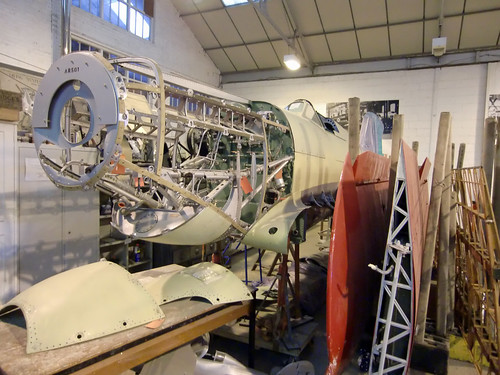 Then, on Monday, we went to a completely different museum which has an equally important backroom function - the Shuttleworth Collection in Old Warden. For those who don't know it - this is a fairly substantial aircraft collection, but most impressively, it's got some old aircraft. That is to say, they have a couple of planes, in actual flying condition, which are over a hundred years old. This puts them in the business of restoration and preservation as much as any museum, which is something they happily talk about; for example, they have a Spitfire (pretty much inevitably, I guess), and one can see it in one hangar - in bits. It needs sprucing up, it seems.
Mind you, aircraft restoration evidently involves a lot of refitting and replacement work. The displays talk about the art of fitting new fabric surfaces (so with some of these aircraft, most of what meets one's gaze is actually new) and the necessity of replacing, say, thousands of magnesium rivets with something newer and less lethally corrosive. But aircraft are machines, built to do something; a restoration process that kept more of the original but left it incapable of flight, would perhaps be too much like taxidermy.
(I grabbed a fair few pictures on Monday, incidentally, of aircraft and also of the adjacent Swiss Garden and Bird of Prey Centre. I'll try and get them up on my Flickr photostream reasonably soon.)
That's one fairly dimly-lit room, mind. One reason that some of these highly significant pieces can't regularly appear on display is clearly that, even more than a lot of art, they're fragile. I won't quite say that they're disintegrating before one's eyes, but some of them certainly look lucky to have lasted this long, and despite all the technical brilliance of modern museums, I'd guess that they have a finite lifespan, even if it can still be measured in centuries. There's a definite sense of the memento mori when one looks at a tiny, fading sketch that was in fact dashed off by Leonardo when he was thinking about how to depict horses and riders, five hundred years ago.
Mind you, aircraft restoration evidently involves a lot of refitting and replacement work. The displays talk about the art of fitting new fabric surfaces (so with some of these aircraft, most of what meets one's gaze is actually new) and the necessity of replacing, say, thousands of magnesium rivets with something newer and less lethally corrosive. But aircraft are machines, built to do something; a restoration process that kept more of the original but left it incapable of flight, would perhaps be too much like taxidermy.
(I grabbed a fair few pictures on Monday, incidentally, of aircraft and also of the adjacent Swiss Garden and Bird of Prey Centre. I'll try and get them up on my Flickr photostream reasonably soon.)
Thursday, May 26, 2011
Conspiracy Theories
Blogger suffers its second problem in a fortnight, leaving me unable to sign in to my account. Then, after a couple of days, I have a bright idea and try using Chrome instead of Firefox - and lo and behold, I get in.
Thus are conspiracy theories born. Google must surely be trying to force people away from the competition and onto their software. Fortunately, (a) I hear that Internet Explorer works too, and (b) I've even been able to get in using Firefox from another computer.
Still, two service collapses in consecutive weeks? Aren't Google supposed to be better than that?
Thus are conspiracy theories born. Google must surely be trying to force people away from the competition and onto their software. Fortunately, (a) I hear that Internet Explorer works too, and (b) I've even been able to get in using Firefox from another computer.
Still, two service collapses in consecutive weeks? Aren't Google supposed to be better than that?
Friday, May 20, 2011
Thor
The superhero movie fashion continues...
Cranking through the list of their major characters as a preparation for the Avengers movie (with lesser Avengers popping up to fan service effect - here, "Agent Barton" spends a couple of minutes on-screen with a bow, just to confuse the non-geeks) and just because, the Marvel films people run head-first into the difficult one. Most superhero movies can be presented as slightly over-exuberant technothrillers, but, well, what the heck can you do with Thor?
Throw a posh British Shakespearean director at it, maybe? Just for Odin's sake don't try to make the original '60s costume work on screen. Which is presumably how Walt and Louise Simonson earn themselves credit mentions alongside the '60s Marvel names, having given the (Marvel) God of Thunder his vaguely plausible suit of armour and his beard. Still, it's all about dropping a clunky modern-fantasy reading of Norse myth into the modern world, and there's only so much anyone can do with that - the script tries a bit of waffle about magic being sufficiently advanced science, but that really doesn't survive a moment's scrutiny - this is sufficiently advanced science that can generate immovable objects, execute conditional operations based on moral judgements made from beyond line of sight, and operate at the mutter of a patriarchal guy in an eye-patch several light-years away. Oh well, at least they didn't try any mumbles about nanotech.
And let's be fair, from a geeky point of view - the visual realisation of a lot of stuff from the comics is really pretty good. The movie also moves fast enough to stop anyone worrying about the obvious glaring logical holes so long as it lasts. (What language do the Asgardians speak? Does Bifrost have a Tardis translation circuit? How old are Thor and Loki? How did they get into human myth if they were born after regular contact between the Nine Worlds ended?) The Casket of Ancient Winters is reduced to a canister of pure distilled Maguffin, though, doing nothing except sit there glowing blue and being important for as long as it's needed; one wonders if early script drafts did more with it, but I wouldn't even bet on that. The visual design for much of Asgard is certainly fun, especially in 3-D - a garish high-fantasy cityscape, rendered with a bit of budget. Bifrost, though, looks like a bad '80s home computer visual effect given unwarranted solidity
The cast is over-qualified, of course, even given that it has some relative newcomers - Chris Hemsworth has fully adequate charm and charisma as well as the body for the lead role, and Tom Hiddleston brings ice-blue eyes and icy elegance to Loki, aided by good direction and costume design which recalls his horned helmet from the comics without getting goofy. (The film has a relatively complex treatment of that character, actually, even if the psychology is a bit Hollywood-routine.) Anthony Hopkins does dignified, Natalie Portman does her best with the career-upgraded Jane Foster, and Idris Elba gives Heimdall plenty of deific dignity. They're fun to watch, but they can never quite suppress the impression that this film exists because the comic exists, and not because it has any great claims to interest in its own right. Still, we get that fight scene between Thor and Loki...
Cranking through the list of their major characters as a preparation for the Avengers movie (with lesser Avengers popping up to fan service effect - here, "Agent Barton" spends a couple of minutes on-screen with a bow, just to confuse the non-geeks) and just because, the Marvel films people run head-first into the difficult one. Most superhero movies can be presented as slightly over-exuberant technothrillers, but, well, what the heck can you do with Thor?
Throw a posh British Shakespearean director at it, maybe? Just for Odin's sake don't try to make the original '60s costume work on screen. Which is presumably how Walt and Louise Simonson earn themselves credit mentions alongside the '60s Marvel names, having given the (Marvel) God of Thunder his vaguely plausible suit of armour and his beard. Still, it's all about dropping a clunky modern-fantasy reading of Norse myth into the modern world, and there's only so much anyone can do with that - the script tries a bit of waffle about magic being sufficiently advanced science, but that really doesn't survive a moment's scrutiny - this is sufficiently advanced science that can generate immovable objects, execute conditional operations based on moral judgements made from beyond line of sight, and operate at the mutter of a patriarchal guy in an eye-patch several light-years away. Oh well, at least they didn't try any mumbles about nanotech.
And let's be fair, from a geeky point of view - the visual realisation of a lot of stuff from the comics is really pretty good. The movie also moves fast enough to stop anyone worrying about the obvious glaring logical holes so long as it lasts. (What language do the Asgardians speak? Does Bifrost have a Tardis translation circuit? How old are Thor and Loki? How did they get into human myth if they were born after regular contact between the Nine Worlds ended?) The Casket of Ancient Winters is reduced to a canister of pure distilled Maguffin, though, doing nothing except sit there glowing blue and being important for as long as it's needed; one wonders if early script drafts did more with it, but I wouldn't even bet on that. The visual design for much of Asgard is certainly fun, especially in 3-D - a garish high-fantasy cityscape, rendered with a bit of budget. Bifrost, though, looks like a bad '80s home computer visual effect given unwarranted solidity
The cast is over-qualified, of course, even given that it has some relative newcomers - Chris Hemsworth has fully adequate charm and charisma as well as the body for the lead role, and Tom Hiddleston brings ice-blue eyes and icy elegance to Loki, aided by good direction and costume design which recalls his horned helmet from the comics without getting goofy. (The film has a relatively complex treatment of that character, actually, even if the psychology is a bit Hollywood-routine.) Anthony Hopkins does dignified, Natalie Portman does her best with the career-upgraded Jane Foster, and Idris Elba gives Heimdall plenty of deific dignity. They're fun to watch, but they can never quite suppress the impression that this film exists because the comic exists, and not because it has any great claims to interest in its own right. Still, we get that fight scene between Thor and Loki...
Wednesday, May 18, 2011
The Extraordinary Adventures of Adèle Blanc-Sec
(Another old post finally being finished...)
To begin with a confession, I suppose - I haven't seen The Mummy, or some of the Indiana Jones movies, or any of the Tomb Raider films, and nor have I read the French bandes dessinées on which this film is based - so I'm probably even less entitled to comment on it than usual. But this blog is only supposed to be about personal reactions anyway, so here we are.
Actually, I think it's the last omission which probably ought to count against me most. I can see why reviewers have been invoking those English-language reference points, but really, this isn't much of a Hollywood-style action movie. Luc Besson may have had some influence in Hollywood over the years, but he's always been a bit too Frenchly odd, and with its lack of a proper villain and focus on a style-soaked female lead, this is very much a Besson movie. More to the point, with its peculiar sense of partial detachment from any sort of reality, its weird dialogue and disregard for much in the way of psychological reality, it's extremely reminiscent of any number of BDs that I have seen, so I suspect it's pretty faithful to its source.
In case you were wondering, Adèle Blanc-Sec, played by the inevitably winsome Louise Bourgoin, is an Edwardian-period adventuress who is, as it turns out, looking for the mummy of an ancient Egyptian doctor so that she can get it resurrected by a loopy academic psychic, because she knows that the ancient Egyptians had the medical knowledge she needs to cure her sister, who is in a coma with a hat-pin through her skull. Unfortunately, though, the psychic has already resurrected an ancient pterodactyl egg, and the pterodactyl is terrorising Paris. Not that Adèle cares about Paris or anyone else much, it seems - family comes first, and Adèle sets out to deal with her own concerns before anything else, leaving a trail of chaos and one or two accidental deaths in her wake...
It's all rather self-consciously French, too, what with the politicians having affairs with cancan dancers and the gendarmes who insist that they are wine connoisseurs and the Eiffel Tower. Yeah, I guess it could even be called charming. Or at least, charmant. Not without its interest, even. More a curiosity than a masterpiece, though.
To begin with a confession, I suppose - I haven't seen The Mummy, or some of the Indiana Jones movies, or any of the Tomb Raider films, and nor have I read the French bandes dessinées on which this film is based - so I'm probably even less entitled to comment on it than usual. But this blog is only supposed to be about personal reactions anyway, so here we are.
Actually, I think it's the last omission which probably ought to count against me most. I can see why reviewers have been invoking those English-language reference points, but really, this isn't much of a Hollywood-style action movie. Luc Besson may have had some influence in Hollywood over the years, but he's always been a bit too Frenchly odd, and with its lack of a proper villain and focus on a style-soaked female lead, this is very much a Besson movie. More to the point, with its peculiar sense of partial detachment from any sort of reality, its weird dialogue and disregard for much in the way of psychological reality, it's extremely reminiscent of any number of BDs that I have seen, so I suspect it's pretty faithful to its source.
In case you were wondering, Adèle Blanc-Sec, played by the inevitably winsome Louise Bourgoin, is an Edwardian-period adventuress who is, as it turns out, looking for the mummy of an ancient Egyptian doctor so that she can get it resurrected by a loopy academic psychic, because she knows that the ancient Egyptians had the medical knowledge she needs to cure her sister, who is in a coma with a hat-pin through her skull. Unfortunately, though, the psychic has already resurrected an ancient pterodactyl egg, and the pterodactyl is terrorising Paris. Not that Adèle cares about Paris or anyone else much, it seems - family comes first, and Adèle sets out to deal with her own concerns before anything else, leaving a trail of chaos and one or two accidental deaths in her wake...
It's all rather self-consciously French, too, what with the politicians having affairs with cancan dancers and the gendarmes who insist that they are wine connoisseurs and the Eiffel Tower. Yeah, I guess it could even be called charming. Or at least, charmant. Not without its interest, even. More a curiosity than a masterpiece, though.
Tuesday, May 17, 2011
Source Code
((Many thanks to the people who sent me copies of this article, after I failed to keep one and Google lost it.))
(More catching up on posts I should have made a month ago. I can just about remember what I meant to say...)
Obvious note; the problem with commenting on this movie is that it's hard to do so without spoilers. And it's honestly good enough not to deserve that.
But, okay, the reviews and trailers have (unavoidably) given away a bit. Not everything, though; a certain amount of layered revelation is part of this film's charm. It's widely described as a time travel story, but what emerges fairly early is that this isn't quite true - or perhaps it is, as it turns out. Choose your own definitions. More annoyingly, a lot of comments seem to describe it as complicated or hard to follow, which suggests to me that too many people's brains just shut down when they're confronted with skiffy ideas about time or any kind of game with causality, because I really didn't see much complexity at all. The explanation of how things seemed to work, and eventually of the film's conclusive twist, struck me as very straightforward, even linear, even if the protagonist did replay the same few minutes of apparent time repeatedly as he went along. Nor was the film quite as rigorous as comments suggested; several of the eight-minute replays that were necessary to the plot would have been too repetitive for any audience, and so were skimmed over.
(Anyone who finds this film unpleasantly hard to follow really, really needs to avoid Primer, by the way.)
In fact, the relatively rigorous approach to plot logic made this a true science fiction story (as opposed to "heroic fantasy in space" or "action thriller with extreme special effects", which is what Hollywood tends to mean by "science fiction" these days), and with Source Code following on Moon, it seems that director Duncan Jones has a genuine and fairly unusual interest in the genre. This isn't hard SF, mind; the core idea of the plot is handwaved fairly frantically, involving as it does multiple scientific and technological jumps far beyond anything that could be made to look hard-SF plausible in the modern-day setting.. In the end, it's using the word "quantum" a lot to justify a fairly arbitrary story with a large dose of wish-fulfilment, even if one could argue that what it does is opt for the Many-Worlds interpretation of quantum mechanics without being so crass as to say so (or to even mention Schrodinger's cat).
Nor is the plotting entirely immaculate; looking back over the film, one can identify significant unanswered questions of both logic and morality. (What could one say about the fate of the original occupant of the body which the hero borrows, for a start?) Still, it is a film about an idea, even if that idea is a bit shaky.
The cast, by the way, are good, and the leads are given enough to get their teeth into. Jake Gyllenhaal makes an effective hero, confused and stressed, far from infallible but ultimately capable enough; Michelle Monaghan is an attractive overt object of desire; Vera Farmiga really carries the film, balancing professionalism with sympathy. Only Jeffrey Wright really has a problem - not that the actor isn't fine, but his character seems unfairly treated. He's vain and unsympathetic, to be sure, but I couldn't help feeling that a man who invented such mind-bending technology would have the right to a very large dose of vanity indeed, and even if that is his main motive for employing it and exploiting the hero, he is actually trying to save thousands or millions of lives in the process. Making the scientist into something of a villain, with silly physical preening to match his intellectual hubris, was the one place where this turned into cheap, bad Hollywood SF.
But if that's the one place, well, we can't complain too much, can we? This isn't the film of the year - probably not even the SF film of the year - but it's a film that I could wish a lot more films were like.
(More catching up on posts I should have made a month ago. I can just about remember what I meant to say...)
Obvious note; the problem with commenting on this movie is that it's hard to do so without spoilers. And it's honestly good enough not to deserve that.
But, okay, the reviews and trailers have (unavoidably) given away a bit. Not everything, though; a certain amount of layered revelation is part of this film's charm. It's widely described as a time travel story, but what emerges fairly early is that this isn't quite true - or perhaps it is, as it turns out. Choose your own definitions. More annoyingly, a lot of comments seem to describe it as complicated or hard to follow, which suggests to me that too many people's brains just shut down when they're confronted with skiffy ideas about time or any kind of game with causality, because I really didn't see much complexity at all. The explanation of how things seemed to work, and eventually of the film's conclusive twist, struck me as very straightforward, even linear, even if the protagonist did replay the same few minutes of apparent time repeatedly as he went along. Nor was the film quite as rigorous as comments suggested; several of the eight-minute replays that were necessary to the plot would have been too repetitive for any audience, and so were skimmed over.
(Anyone who finds this film unpleasantly hard to follow really, really needs to avoid Primer, by the way.)
In fact, the relatively rigorous approach to plot logic made this a true science fiction story (as opposed to "heroic fantasy in space" or "action thriller with extreme special effects", which is what Hollywood tends to mean by "science fiction" these days), and with Source Code following on Moon, it seems that director Duncan Jones has a genuine and fairly unusual interest in the genre. This isn't hard SF, mind; the core idea of the plot is handwaved fairly frantically, involving as it does multiple scientific and technological jumps far beyond anything that could be made to look hard-SF plausible in the modern-day setting.. In the end, it's using the word "quantum" a lot to justify a fairly arbitrary story with a large dose of wish-fulfilment, even if one could argue that what it does is opt for the Many-Worlds interpretation of quantum mechanics without being so crass as to say so (or to even mention Schrodinger's cat).
Nor is the plotting entirely immaculate; looking back over the film, one can identify significant unanswered questions of both logic and morality. (What could one say about the fate of the original occupant of the body which the hero borrows, for a start?) Still, it is a film about an idea, even if that idea is a bit shaky.
The cast, by the way, are good, and the leads are given enough to get their teeth into. Jake Gyllenhaal makes an effective hero, confused and stressed, far from infallible but ultimately capable enough; Michelle Monaghan is an attractive overt object of desire; Vera Farmiga really carries the film, balancing professionalism with sympathy. Only Jeffrey Wright really has a problem - not that the actor isn't fine, but his character seems unfairly treated. He's vain and unsympathetic, to be sure, but I couldn't help feeling that a man who invented such mind-bending technology would have the right to a very large dose of vanity indeed, and even if that is his main motive for employing it and exploiting the hero, he is actually trying to save thousands or millions of lives in the process. Making the scientist into something of a villain, with silly physical preening to match his intellectual hubris, was the one place where this turned into cheap, bad Hollywood SF.
But if that's the one place, well, we can't complain too much, can we? This isn't the film of the year - probably not even the SF film of the year - but it's a film that I could wish a lot more films were like.
The Cloud Ate My Homework
Just in case anyone noticed a post about Source Code (the movie) here a few days ago, and is wondering what happened to it - evidently Google/Blogger had a little problem late last week, which meant that they had to roll everything on Blogger back a couple of days, then restore stuff one thing at a time.
Oh well, stuff happens.
Then they announced that they'd got just about everything restored by the end of Saturday or thereabouts. Evidently, my last post didn't fit under "just about everything". (Nor, to judge by the support boards, did a fair number of others.) Google are being deeply silent about when the remaining stuff will be restored, if ever. I'm not bothering to reconstruct that post from memory yet, because you never know, they might yet actually deliver on their initial promises.
One criticism of the whole trendy concept of "cloud computing" is that you're trusting your data security to some other party. (Conversely, one thing to be said for it is that it provides inherent off-site backups.) Well, all I've lost, at worst, is an hour or so's opinionated noodling. No big deal. But that loss has reminded me that I need to keep my on-site backups up to date.
(It's also shown me that Google's support people are as prone as any to go into vacuous cut-and-paste arse-covering BS mode when trouble strikes. Big surprise there.)
Oh well, stuff happens.
Then they announced that they'd got just about everything restored by the end of Saturday or thereabouts. Evidently, my last post didn't fit under "just about everything". (Nor, to judge by the support boards, did a fair number of others.) Google are being deeply silent about when the remaining stuff will be restored, if ever. I'm not bothering to reconstruct that post from memory yet, because you never know, they might yet actually deliver on their initial promises.
One criticism of the whole trendy concept of "cloud computing" is that you're trusting your data security to some other party. (Conversely, one thing to be said for it is that it provides inherent off-site backups.) Well, all I've lost, at worst, is an hour or so's opinionated noodling. No big deal. But that loss has reminded me that I need to keep my on-site backups up to date.
(It's also shown me that Google's support people are as prone as any to go into vacuous cut-and-paste arse-covering BS mode when trouble strikes. Big surprise there.)
Monday, May 09, 2011
Concert: Neil Innes
(More catching up on a bunch of posts that have been sitting around half-finished for far too long.)
The Junction, Cambridge, 29th March 2011.
At 8 o'clock in the evening of March 29th - the scheduled start time, good heavens - an amiable old buffer in a waistcoat and beret ambled on stage and launched into a show which lasted a couple of hours, with an interval...
The last time I saw Neil Innes on stage was thirty-something years ago, when he was basically playing the good stuff from his TV series of the time. This older, plumper, greyer Innes was playing something a bit less formal and structured and a bit more relaxed. I think that there was stuff from a radio series, but I confess I'm not familiar enough with his repertoire; there was certainly little sense of product to sell, except perhaps for retrospective collections. There was a bit of chat between songs, some of it going back to the foundation of the Bonzo Dog Doo-Dah Band (basically, a bunch of London art students bonded over a taste for not-very-good pre-war British trad jazz) and including recollections of that band's somewhat edgier leading light, Viv Stanshall, as well as some mention of Monty Python and the Rutles. It was all very pleasant. Innes, it must be said, clearly isn't very edgy at heart. Gentle comic melancholy is more his style. There were some comments that might have been taken to relate to contemporary politics, but they were at the level of general benevolence than satirical ferocity.
And yet - it wasn't hard to remember that this man has provided musical underpinnings for the defining Anglophone comedy of the last half-century. This is Sir Robin's minstrel and Ron Nasty. This is someone to catch up with from time to time.
The Junction, Cambridge, 29th March 2011.
At 8 o'clock in the evening of March 29th - the scheduled start time, good heavens - an amiable old buffer in a waistcoat and beret ambled on stage and launched into a show which lasted a couple of hours, with an interval...
The last time I saw Neil Innes on stage was thirty-something years ago, when he was basically playing the good stuff from his TV series of the time. This older, plumper, greyer Innes was playing something a bit less formal and structured and a bit more relaxed. I think that there was stuff from a radio series, but I confess I'm not familiar enough with his repertoire; there was certainly little sense of product to sell, except perhaps for retrospective collections. There was a bit of chat between songs, some of it going back to the foundation of the Bonzo Dog Doo-Dah Band (basically, a bunch of London art students bonded over a taste for not-very-good pre-war British trad jazz) and including recollections of that band's somewhat edgier leading light, Viv Stanshall, as well as some mention of Monty Python and the Rutles. It was all very pleasant. Innes, it must be said, clearly isn't very edgy at heart. Gentle comic melancholy is more his style. There were some comments that might have been taken to relate to contemporary politics, but they were at the level of general benevolence than satirical ferocity.
And yet - it wasn't hard to remember that this man has provided musical underpinnings for the defining Anglophone comedy of the last half-century. This is Sir Robin's minstrel and Ron Nasty. This is someone to catch up with from time to time.
Trailer Trash (in 3-D)
Went to see Thor on Saturday, about which I may blog more properly in due course. However, because I went to see the 3-D version, I also got to see a bunch of 3-D trailers.
Oh, dear.
As I may have demonstrated here in the past, I do have a certain horribly naive fondness for this technology, although I'd some time since begun to notice that it worked best in computer-animated movies which were designed that way from the beginning, and which could make amiable jokes about the subject. Thor, incidentally, uses 3-D fairly well, or at least harmlessly - there's a vague sense at times that one has a lava lamp exploding in one's face, and it probably makes the big early fight scene even less comprehensible than it would be in 2-D, but on the other side, there's a pleasing sense of grandiose fantasy art coming to LIFE, kerrpow!
Anyway, from the trailers, well, the 3-D in Kung-Fu Panda 2 is probably likely going to be mostly tolerable, because it's another computer animation - I may well go see it (and yes, I have just expressed moderately keen anticipation for a film called Kung-Fu Panda 2.) But the trailer for Pirates of the Caribbean: On Stranger Tides made me utterly determined that, if I go see it in a cinema, it'll only ever be in 2-D.
The problem is clearly the post-processing of a live-action film, shot in 2-D, into the third dimension. This doesn't have to be done too badly, to go by other films, but the visual effect in this case was quite horrible and a bit surreal. It was like watching full-colour cut-out pictures of Johnny Depp and Penelope Cruz being slid around a toy theatre lined with similarly flat background pictures.
Priest, by the way, appears from its trailer to be a bad joke.
Oh, dear.
As I may have demonstrated here in the past, I do have a certain horribly naive fondness for this technology, although I'd some time since begun to notice that it worked best in computer-animated movies which were designed that way from the beginning, and which could make amiable jokes about the subject. Thor, incidentally, uses 3-D fairly well, or at least harmlessly - there's a vague sense at times that one has a lava lamp exploding in one's face, and it probably makes the big early fight scene even less comprehensible than it would be in 2-D, but on the other side, there's a pleasing sense of grandiose fantasy art coming to LIFE, kerrpow!
Anyway, from the trailers, well, the 3-D in Kung-Fu Panda 2 is probably likely going to be mostly tolerable, because it's another computer animation - I may well go see it (and yes, I have just expressed moderately keen anticipation for a film called Kung-Fu Panda 2.) But the trailer for Pirates of the Caribbean: On Stranger Tides made me utterly determined that, if I go see it in a cinema, it'll only ever be in 2-D.
The problem is clearly the post-processing of a live-action film, shot in 2-D, into the third dimension. This doesn't have to be done too badly, to go by other films, but the visual effect in this case was quite horrible and a bit surreal. It was like watching full-colour cut-out pictures of Johnny Depp and Penelope Cruz being slid around a toy theatre lined with similarly flat background pictures.
Priest, by the way, appears from its trailer to be a bad joke.
Friday, May 06, 2011
Theatre (sort of): Frankenstein
(I'm catching up - partially, slowly - on an embarrassingly long string of blog posts that are sitting on the system in incomplete draft mode. Hence the age of this one)
National Theatre, London, transmitted to the Arts Cinema, Cambridge, 24/03/2011
 Another live broadcast from the National Theatre to the Arts Cinema in Cambridge, and this time it's the hot ticket of the London theatre season - Nick Dear and Danny Boyle's stage treatment of one of the key modern myths
 . Which turned out to be pretty good and quite well suited to high-definition broadcast to cinema, with a certain amount of playing with camera angles and viewpoints, and enough chances to observe the stage design, especially the giant chandelier laden with as many different types of light bulb as someone could find.
It was all a pretty consciously stagey sort of production, with a consciously brave wordless extended opening scene as the creature was born, a brief outburst of steampunk as it encountered some horrified urban proles, and lots of colourblind casting. One problem, perhaps, was that Jonny Lee Miller looked merely rugged and a bit scarred as the creature, while everyone who met him was obliged to react as though he was some kind of nigh-Lovecraftian abomination; even given the level of abstraction in the visuals, I found it hard to suspend disbelief quite enough there.
But we all know that the monster is hideous, don't we? Like I said, modern myth. It's been a while since I read the novel, and once or twice I found myself trying to remember whether some elements came from there, or whether they'd sneaked in from the films - the elderly exiled intellectual in the woodland cottage is in the book, of course, but was he originally blind? Actually, yes - Dear follows Shelley quite faithfully in that scene, but in so doing, can't help but remind audiences of the movies (including Young Frankenstein). No great matter, to be sure, but it's all a reminder of the potential complexities involved in adapting a text as time-crusted as this one.
But yes, Dear's script did cleave to the core myth fairly well throughout- although it always seems a shame that Robert Walton, the Arctic explorer, so rarely makes it into adaptations, even when, like this one, they end in the Arctic. (The absence of that observer made the ending a bit anticlimactic, I'm afraid.) The one rather jarring and consciously "modern" - though actually rather dated-seeming - inclusion was some pointedly feminist stuff about Frankenstein being a heartless male scientist who needed to pay more attention to nice intuitive feminine ethics, or at least to listen when his fiancée asked if she could learn about his work. Okay, okay, so Mary Shelley has a significant part in feminist history, and certainly, if you look at Frankenstein's behaviour at all seriously, he treats Elizabeth abominably - but if you're going to treat that relationship at all logically, then there's no good reason for her to put up with him at all (apart from the dominant influence of the rest of the family). The only effect of this added stuff, for me, was a sense of 1970s right-onnery lurching into the middle of this Georgian gothic-romantic lunacy.
Probably, in fact, the production should have gone all-out for gothic effect, and forget any attempts to inject a modern moral consciousness or to explore the relationship between creator and creature. (Benedict Cumberbatch was more than fine as Victor, by the way, leaving me curious as to how the alternate-nights presentations, with him as the monster and Miller as Victor, played out. The idea felt wrong, but that may just say something about Cumberbatch's skill as an actor.) Mary Shelley was being entirely morally serious, yes, but on a topic which has been thrashed out every which way and tackled by two hundred years' worth of political thinkers and science fiction writers. At the risk of sounding all post-modernist, it really isn't the same story now that it was then, even if you tell it in the same words.
But it's a story that's survived for a good reason, and it's always interesting to watch experts having another go at this sort of thing. And nice to see technology being expertly and benevolently applied to bring it to a wider audience.
National Theatre, London, transmitted to the Arts Cinema, Cambridge, 24/03/2011
. Which turned out to be pretty good and quite well suited to high-definition broadcast to cinema, with a certain amount of playing with camera angles and viewpoints, and enough chances to observe the stage design, especially the giant chandelier laden with as many different types of light bulb as someone could find.It was all a pretty consciously stagey sort of production, with a consciously brave wordless extended opening scene as the creature was born, a brief outburst of steampunk as it encountered some horrified urban proles, and lots of colourblind casting. One problem, perhaps, was that Jonny Lee Miller looked merely rugged and a bit scarred as the creature, while everyone who met him was obliged to react as though he was some kind of nigh-Lovecraftian abomination; even given the level of abstraction in the visuals, I found it hard to suspend disbelief quite enough there.
But we all know that the monster is hideous, don't we? Like I said, modern myth. It's been a while since I read the novel, and once or twice I found myself trying to remember whether some elements came from there, or whether they'd sneaked in from the films - the elderly exiled intellectual in the woodland cottage is in the book, of course, but was he originally blind? Actually, yes - Dear follows Shelley quite faithfully in that scene, but in so doing, can't help but remind audiences of the movies (including Young Frankenstein). No great matter, to be sure, but it's all a reminder of the potential complexities involved in adapting a text as time-crusted as this one.
But yes, Dear's script did cleave to the core myth fairly well throughout- although it always seems a shame that Robert Walton, the Arctic explorer, so rarely makes it into adaptations, even when, like this one, they end in the Arctic. (The absence of that observer made the ending a bit anticlimactic, I'm afraid.) The one rather jarring and consciously "modern" - though actually rather dated-seeming - inclusion was some pointedly feminist stuff about Frankenstein being a heartless male scientist who needed to pay more attention to nice intuitive feminine ethics, or at least to listen when his fiancée asked if she could learn about his work. Okay, okay, so Mary Shelley has a significant part in feminist history, and certainly, if you look at Frankenstein's behaviour at all seriously, he treats Elizabeth abominably - but if you're going to treat that relationship at all logically, then there's no good reason for her to put up with him at all (apart from the dominant influence of the rest of the family). The only effect of this added stuff, for me, was a sense of 1970s right-onnery lurching into the middle of this Georgian gothic-romantic lunacy.
Probably, in fact, the production should have gone all-out for gothic effect, and forget any attempts to inject a modern moral consciousness or to explore the relationship between creator and creature. (Benedict Cumberbatch was more than fine as Victor, by the way, leaving me curious as to how the alternate-nights presentations, with him as the monster and Miller as Victor, played out. The idea felt wrong, but that may just say something about Cumberbatch's skill as an actor.) Mary Shelley was being entirely morally serious, yes, but on a topic which has been thrashed out every which way and tackled by two hundred years' worth of political thinkers and science fiction writers. At the risk of sounding all post-modernist, it really isn't the same story now that it was then, even if you tell it in the same words.
But it's a story that's survived for a good reason, and it's always interesting to watch experts having another go at this sort of thing. And nice to see technology being expertly and benevolently applied to bring it to a wider audience.
Thursday, May 05, 2011
Expand, Contract (29)
Just a note in passing - the first draft of my latest (big) project finally went in on Monday. So now I'm catching up on a whole stack of non-writing, non-games stuff that had been pushed aside.
Hopefully, another (small) Transhuman Space editing project will be along fairly soon.
Sorry I can't really say much more about this stuff just now.
Hopefully, another (small) Transhuman Space editing project will be along fairly soon.
Sorry I can't really say much more about this stuff just now.
Friday, April 15, 2011
Cities on the Edge - After-Note
Just a note in passing, as I suspect one or two people coming here might be interested; Cities on the Edge has been the subject of a few posts and pages elsewhere on the Web. Author Anders Sandberg has blogged about it, and co-author Waldemar Ingdahl has done so twice, once for gamers and once for futurists. It's also sold well enough to merit a mention on RPG Countdown, among other places.
Also...
The book ended up with (mostly) original line art commissioned by Steve Jackson Games. However, at one stage, when the art budget looked a little questionable, I suggested that some processed B&W photographic imagery might work. The company disagreed, but for those who are curious, here's what might almost have become my first art credits in the RPG business after thirty years of writing:


Also...
The book ended up with (mostly) original line art commissioned by Steve Jackson Games. However, at one stage, when the art budget looked a little questionable, I suggested that some processed B&W photographic imagery might work. The company disagreed, but for those who are curious, here's what might almost have become my first art credits in the RPG business after thirty years of writing:


Sunday, March 20, 2011
Rango
 It is a well-known fact that, because of the insane amounts of money involved in making a Hollywood movie, the companies are terrified of taking chances on anything at all unlike that which has made money in the past. Which explains why the dull predictability of so much Hollywood output.
However, every once in a while, a director with a record of financial success can slip something odd past all those filters. And animation is partly immune to the problem because the money people don't understand it yet and anyway they expect it to be a bit weird...
"It's a post-modernist surrealist western, set in the modern day, with Johnny Depp as a delusional chameleon on a vision quest."
"Okay."
I mean, the @$*#?
It's also utterly beautiful, by the way, with truly astonishing creature designs and the most gorgeous landscapes I've ever seen in a computer-animated movie (which is saying something for a field which has let quite so many skilled artists have quite so much fun in the last ten years). It seemed that, every time the plot started becoming predictable or conventional (which it does from time to time), the animators were instructed to make the pictures on the screen even more breath-taking. And it's frequently utterly hilarious. I'm just glad that I didn't have to explain it to a ten-year-old being taken along to see a funny-animals movie on a wet Saturday afternoon.
Thursday, March 10, 2011
Expand, Contract (28)

Monday, February 21, 2011
Concert: British Sea Power
The Junction, Cambridge, 20th February 2011.
British Sea Power are one of those bands that come along every few years to reaffirm one's faith in the basic guitar-band model of rock - even if they do have a cornet and an electric viola underpinning the guitars, and sing love songs to Antarctic ice sheets or create new soundtracks to 1930s documentaries. So when they turned up in Cambridge, I went along to see how they were live.
But first, there was the support band, Bo Ningen, who I guess can be described as some kind of mutant Japanese thrash metal. They opened with the sort of apocalyptic noise that a heavy metal band might use as a climax, then carried on from there. Works for some people, I guess.
Then, after half an hour in which the roadies attached assorted foliage to the mike stands, British Sea Power were on, kicking off with "Who's in Control", the opening track from their latest album. They turned out to be a well-rehearsed, capable bunch, albeit that their down-the-line rock approach on stage lost some of the breathy atmospherics of their recorded work. It's what the crowd wants, of course, and they may have given something of a hostage to fortune with the football-chant refrain in "No Lucifer" - the front rows of the audience were anticipating it some time before it came along - but there's no denying it's a good song, and they followed it with the punchy "Stunde Null" to hammer something home. That was around the middle of the set, after "Larsen B", "Something Wicked", and "Lights Out", and some of the subsequent songs weren't quite so interesting, making me wonder if they'd shot their bolt rather - but then they delivered "Living is so Easy" followed by "Waving Flags", which nailed that worry. "It Ended on an Oily Stage" showed up, too.
From where I was standing, British Sea Power seem caught in tension between being a crisply efficient, conventional guitar band, following the fifty-year-old script of "finishing" and then playing an encore and so forth, and being something a little bit more idiosyncratic and whimsical and British-rock-surrealist, with decorated stages, violas, and back-projected movie snippets. But they're actually rather good at both, so I'm not complaining at all.
British Sea Power are one of those bands that come along every few years to reaffirm one's faith in the basic guitar-band model of rock - even if they do have a cornet and an electric viola underpinning the guitars, and sing love songs to Antarctic ice sheets or create new soundtracks to 1930s documentaries. So when they turned up in Cambridge, I went along to see how they were live.
But first, there was the support band, Bo Ningen, who I guess can be described as some kind of mutant Japanese thrash metal. They opened with the sort of apocalyptic noise that a heavy metal band might use as a climax, then carried on from there. Works for some people, I guess.
Then, after half an hour in which the roadies attached assorted foliage to the mike stands, British Sea Power were on, kicking off with "Who's in Control", the opening track from their latest album. They turned out to be a well-rehearsed, capable bunch, albeit that their down-the-line rock approach on stage lost some of the breathy atmospherics of their recorded work. It's what the crowd wants, of course, and they may have given something of a hostage to fortune with the football-chant refrain in "No Lucifer" - the front rows of the audience were anticipating it some time before it came along - but there's no denying it's a good song, and they followed it with the punchy "Stunde Null" to hammer something home. That was around the middle of the set, after "Larsen B", "Something Wicked", and "Lights Out", and some of the subsequent songs weren't quite so interesting, making me wonder if they'd shot their bolt rather - but then they delivered "Living is so Easy" followed by "Waving Flags", which nailed that worry. "It Ended on an Oily Stage" showed up, too.
From where I was standing, British Sea Power seem caught in tension between being a crisply efficient, conventional guitar band, following the fifty-year-old script of "finishing" and then playing an encore and so forth, and being something a little bit more idiosyncratic and whimsical and British-rock-surrealist, with decorated stages, violas, and back-projected movie snippets. But they're actually rather good at both, so I'm not complaining at all.
Thursday, January 06, 2011
English, Evolving and Evolved

Actually, this felt a bit like two exhibitions. The first, smaller room was about the emergence of Old English, and then its evolution into Middle English - illustrated by stuff mostly (I assume) from the Library's own collections. This was where one got to see an ivory plaque carved with ancient runes, the original manuscript of Beowulf, samples of Henry V's handwriting (apparently he was the first English king to send letters in English), an Anglo-Saxon Chronicle... Little things like that. A small exhibition, but kind of in-your-face seriously impressive.
Then there was the second, larger room, which was less chronological and more thematic, full of relatively recent texts and manuscripts and sound recordings playing over headphones. I mean, Tyndale Bibles and Caxton printed books (and copies of Viz and John Betjeman manuscripts and "Murder on the Dancefloor" as allegedly the first pop hit to be sung in pure RP), to be sure, but less sense of mists-of-time depth than the first room. On the other hand, it was fascinating stuff; see the Web page for some of the star items. The Shakespeare texts read in what is believed to be period style (i.e. kind of West Country rural) were fun, certainly; the bit of King Lear was oddly less disconcerting than "Now is the winter of ooor discontant.." Nicely presented, too, even if one of the two screens playing TV and radio comedy as examples of the way English can be used was on the blink. (So I had to wait awhile to see Fourcandles and the Goons.)
Anyway, generally recommended if you're in London in the next few months.
Wednesday, December 29, 2010
Dr Who 2010(a)
Generic criticism; "science fantasy" is a bastard genre that lacks any inherent discipline. If anything is possible, nothing means anything.
Case in point...
Oh, okay, the Christmas Special wasn't that bad. It was done with a certain amount of panache, and it had its moments. It was also interesting as perhaps the first Who Christmas Special that really tried to be about Christmas in some significant way - although I imagine that all the stuff about midwinter festivals may make it a hard sell in Southern Hemisphere markets.
But the structure was all over the shop. The snag with the 21st century Doctor-as-demigod pattern is that it's hard to present him with a truly worrying challenge, and this story got wildly arbitrary in the attempt to get around that. When your magic-wand-sorry-sonic-screwdriver can do anything to any machine, having it not work on some not-very-wizzy-looking contraption is just unconvincing. When your hero's vehicle has towed whole planets around, being unable to rescue one modest-looking spaceship which is crashing very slowly just looks incompetent. And when you're running round history as a plot convenience, having a heroine suffer from a 19th-century-opera terminal disease - one that gives her one day to live but no visible symptoms - is going to look plain goofy to even the eight-year-olds watching. Maybe it is incurable, in all of time and space, but somebody ought to think to try.
Which reminds me, general hint to TV writers; virtually everyone knows how long the programme they're watching will run for. Therefore, having someone announce that your hero has got "just under an hour" to solve a problem at the start of the episode slices suspension of disbelief into tiny bleeding ribbons. See Nick Lowe's The Well-Tempered Plot Device for further discussion.
Also on the matter of time; it's been observed before, by smarter people than me, that Steven Moffat really loves plots that play games with time and causality. Sometimes, this has produced very good stories (starting back with Coupling). But putting him in charge of a series about a guy with a time machine may be too much like putting a child in charge of a sweetshop. Sending the Doctor up and down someone's personal timeline is the kind of time-meddling that Doctor Who has customarily avoided - and allowing people to meet older and younger versions of themselves is usually, canonically, treated as a bad thing. This thing about time is beginning to look like Moffat's hubris.
(Also, I guess having the special effects shark spring forward with jaws agape may just have been a conscious reference to Back to the Future 2, but if so, it was tempting fate. Who FX aren't so good these days that you can afford to remind people of famous lines about crap special effects.)
But regarding science fantasy... The defence of such things, when they're compared to science fiction, is that (like most competent fantasy) they invoke poetic and emotional truths rather than brute rationalism. Well, maybe. But aside from the fact that, when you're deploying the rationalist paraphernalia of science fiction, this is in danger of looking like mawkish tosh, the fact is that you have to make the poetic truths convincing. Chucking in a lot of carol singing and a carriage pulled by a flying shark doesn't cut it.
In other words; Bah, humbug.
(The trailer for next year's episodes after the credits looked moderately amusing, by the way, with no daleks or cybermen even. But I did glimpse a bloody ood. Unless we're going to get a story in which an arch-villain intervenes in their evolutionary history to transform them into the most stupid race in the history of biology, I shall be very cross.)
Case in point...
Oh, okay, the Christmas Special wasn't that bad. It was done with a certain amount of panache, and it had its moments. It was also interesting as perhaps the first Who Christmas Special that really tried to be about Christmas in some significant way - although I imagine that all the stuff about midwinter festivals may make it a hard sell in Southern Hemisphere markets.
But the structure was all over the shop. The snag with the 21st century Doctor-as-demigod pattern is that it's hard to present him with a truly worrying challenge, and this story got wildly arbitrary in the attempt to get around that. When your magic-wand-sorry-sonic-screwdriver can do anything to any machine, having it not work on some not-very-wizzy-looking contraption is just unconvincing. When your hero's vehicle has towed whole planets around, being unable to rescue one modest-looking spaceship which is crashing very slowly just looks incompetent. And when you're running round history as a plot convenience, having a heroine suffer from a 19th-century-opera terminal disease - one that gives her one day to live but no visible symptoms - is going to look plain goofy to even the eight-year-olds watching. Maybe it is incurable, in all of time and space, but somebody ought to think to try.
Which reminds me, general hint to TV writers; virtually everyone knows how long the programme they're watching will run for. Therefore, having someone announce that your hero has got "just under an hour" to solve a problem at the start of the episode slices suspension of disbelief into tiny bleeding ribbons. See Nick Lowe's The Well-Tempered Plot Device for further discussion.
Also on the matter of time; it's been observed before, by smarter people than me, that Steven Moffat really loves plots that play games with time and causality. Sometimes, this has produced very good stories (starting back with Coupling). But putting him in charge of a series about a guy with a time machine may be too much like putting a child in charge of a sweetshop. Sending the Doctor up and down someone's personal timeline is the kind of time-meddling that Doctor Who has customarily avoided - and allowing people to meet older and younger versions of themselves is usually, canonically, treated as a bad thing. This thing about time is beginning to look like Moffat's hubris.
(Also, I guess having the special effects shark spring forward with jaws agape may just have been a conscious reference to Back to the Future 2, but if so, it was tempting fate. Who FX aren't so good these days that you can afford to remind people of famous lines about crap special effects.)
But regarding science fantasy... The defence of such things, when they're compared to science fiction, is that (like most competent fantasy) they invoke poetic and emotional truths rather than brute rationalism. Well, maybe. But aside from the fact that, when you're deploying the rationalist paraphernalia of science fiction, this is in danger of looking like mawkish tosh, the fact is that you have to make the poetic truths convincing. Chucking in a lot of carol singing and a carriage pulled by a flying shark doesn't cut it.
In other words; Bah, humbug.
(The trailer for next year's episodes after the credits looked moderately amusing, by the way, with no daleks or cybermen even. But I did glimpse a bloody ood. Unless we're going to get a story in which an arch-villain intervenes in their evolutionary history to transform them into the most stupid race in the history of biology, I shall be very cross.)
Thursday, December 23, 2010
Expand, Contract (27)

The hardcopy version should come later, but right now, the PDF is on DriveThruRPG.com. You can buy the book alone, or the "hack pack" which includes some extra stuff.
Monday, December 06, 2010
Spanish Photos
Just a note - I've finally finished sorting through our photos from last month's trip to Spain and putting the interesting ones up on my Flickr Account.
Monday, November 15, 2010
The Orange and the Red
Spain, October 31st-November 5th.
One snag with being a bit averse to overly hot weather - by UK standards - and thus prone to taking holidays in places that are climatically temperate, is that quite a lot of stuff that one really doesn't want to miss in a lifetime is draped around the Mediterranean.So, this year, we decided to try a workaround; taking a short break to points south in a cool month. Pictures are going up a few at a time over at my Flickr pages; consider this to be the supporting notes.
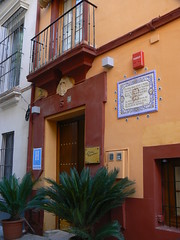 Sunday: We took an afternoon flight out of Heathrow, followed by a couple of buses through Seville, and we eventually tracked down the hotel we'd booked. La Casa del Maestro turned out to be a lovely little nigh-boutique place tucked away down a side street on the slightly scruffy north side of central Seville - but then, as we realised the next morning, everything in central Seville is tucked away down a side street. The major streets are tucked away down side streets. Honestly, I thought that I'd seen medieval street plans before, but then I saw Seville...
This being Spain, we had no difficulty finding a dinner quite late in the evening, albeit a snack-ish - sorry, tapas - sort of dinner, in a little nearby bar-restaurant that the guidebook suggested. And we slept okay despite a local church bell that seems to keep going on the hour and half-hour all night.
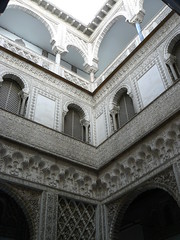 Monday: We'd only booked for a day and a bit in Seville, and examination of that guidebook suggested that the Real Alcazar was the number one priority. So we made our way down the maze of twisty little passages, all alike, that counts as a street plan in those parts (people drive in this place? aargh), passed the fancy city hall and the gigantic Gothic cathedral (complete with repurposed minaret as its bell-tower), and joined the short queue...
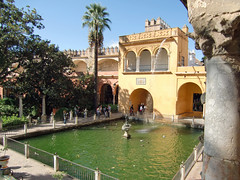 A few hours later, we staggered out in a state of mild aesthetic overload. I mean, I've heard of the idea of a building as a work of art in its own right - but I'd never actually experienced anything quite like this. Touring he entire palace complex (and attached gardens) is like being on the inside of a giant, exquisite jewel box, a Moorish-Spanish masterpiece of screens and arches and pools and tiles. It's a work of abstract art, mind you, with the Moorish influence ensuring that there was very little representational going on, but utterly breathtaking as an exercise in pure form. This decorative style ensured that moving from the carved or moulded interiors to the palm-filled gardens felt utterly natural, too. The realisation that history was made here - that Columbus and the colonial projects that followed him were sent from these interlocking chambers - was, well, not exactly icing on the cake, because this is one well-iced cake already.
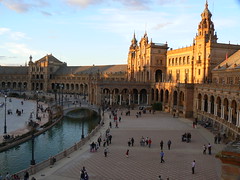 After that, a stroll round the city seemed in order. We basically started in the Jardines de Murillo and struck north, past that cathedral and some other central sights and eventually crossing the River Guadalquivir and getting into the old ceramic-makers' district. (And with all the tiles around this city, it was clear that this was an important district in its time.) Then we headed back southwards, eventually re-crossing the river to pass the old Royal Tobacco Factory (thank you, Merimee and Bizet) and reach the Parque Maria Luisa. We had time for a quick look at the park and the huge Plaza de Espana (left over from the great Exposition of 1929) before dusk began to encroach, and we headed back to the hotel.
Oh, and after steering round a late-night religious procession, complete with band (just to confirm that we were in Spain, I guess), we had dinner in El Rinconcillo, which is supposed to be the oldest restaurant in the city, dating back to 1670. Decent southern Spanish stuff, I'd say. The restaurant apparently sometimes claims to be where tapas was invented, but I'd imagine a lot of Ancient Roman popina-keepers raising an eyebrow about that.
 Tuesday: Our train was at 11:50, so we had time for another quick look around Seville, with another look at the exteriors of some buildings we'd missed the day before - then we were off to the railway station.Judging by the two we caught on this trip, Spanish trains are fine, albeit a bit basic and with little in the way of on-board catering, so we spent three hours rolling across an increasingly rugose Mediterranean countryside of olive groves and the odd cactus, and reached Granada by early afternoon. Then we spent rather too long trying to track down our hotel - we really should have downloaded better maps before we set out - before we found ourselves next to a taxi rank, and resorted to just getting into a cab and asking to be taken there. The Hotel Guadalupe proved not to be quite as cool as the Casa del Maestro, being rather more of a stock tourist place - but then, it was significantly cheaper, we got a positively cavernous room, and the place was more or less right outside the entrance to the Alhambra. Not that we were going in there that day; rather, we strolled down and round the hill to look around the Albaicin, Granada's old town. "Picturesque" is the keyword there.
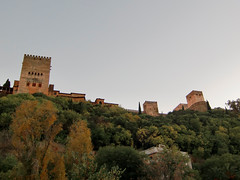 Dinner, in Ruta del Azafran in the Albaicin, should have been good. Traditional southern Spanish dishes with a modern twist, in a stylish restaurant with views of the floodlit walls of the Alhambra. Furthermore, the execution was highly competent. Okay, my Remojón Granadino was maybe in the "try it once for the interest" category - a salad of potatoes, olives, and salt code is fine, if a bit bland here, but adding orange just seems perverse, even if it is "traditional" - but it was no more than the menu promised, and it was by no means unpleasant.
However, at some point during our three-quarter-hour wait for my dessert (a rather nice dark chocolate cake, not too sweet, accompanied by a matching custard that I'm happy to believe was actually Cava zabaglione like the menu said), long after the dessert wine had arrived and been consumed, I began to notice too much about the place. The atonal avant-garde music on the hi-fi, for a start. Then I went to the loos, which were labelled "boys" and "girls" on the door in multiple languages... Yeah, two unisex cubicles, except that the lights in one were gone and nobody was doing anything about it. On the way back to the table, I managed to suppress my invisibility-to-waiters field for long enough to prompt ours, much to his surprise, which is probably why the cake arrived before midnight. When we subsequently got the bill out of a different (but equally black-clad) waiter, it didn't include the dessert, which I chose to take as an apology- but it did include a couple of Euros for the two bread rolls which had arrived at the table automatically, as if free...
I'm prepared to believe that what we had here was a highly competent kitchen being let down by a front-of-house organisation so far up itself that those waiters only see daylight when they yawn. But then, I dunno who cocked up the dessert order (though I know who neglected to say anything to us about it). We only left a token tip, which was probably a mistake; none at all would have felt justified.
 Wednesday: There's one reason to come to Granada, really, and our hotel was just yards away from the entrance. The Alhambra has a reputation as another building-as-artistic-masterpiece, and that's fully justfied - but primarily by two specific parts of the hilltop complex. Our timed entrance tickets for the Nasrid Palaces were for late enough in the morning that we had time to stroll through some of the grounds, pass through the Puerta del Vino, and visit the Alcazaba - the medieval castle at the tip of the hilltop complex, with magnificent views over the city and across to the mountains,
And then there was that Palace. Yup, it lives up to the hype. Well, the standard tourist route takes you through some merely impressive rooms first - then it hits you with the Court of the Myrtles, which is one of those justifies-the-trip things. The only snag with our timing was that the Court of the Lions is being massively refurbished, so we found the lions themselves in a side-room, showing off the radical clean-up that they've received, while the Court itself had a lot of scaffolding. (Made me feel like I was back in Cambridge...) Maybe we go back in a few years when they've got that little architectural gem back in full working order; even in its current state, the small forest of slender arches and carved screens still hints at the genius of the thing.
Anyway, after a stroll round the apartments where Washington Irving stayed, and the chance to admire the views and all, we wandered out into the merely superb remains of the Partal Palace, before making an indirect way to the other unique architectural masterpiece - the Generalife. (This is in the guidebooks as a separate site, but actually it's all part of the Alhambra deal.) Angela notes that you can't open a book on garden history without finding pictures of this, and it's really not hard to see why. It's kind of an exercise in gratuitously elegant Islamic garden design. With fountains. Twice. With extra beautiful stuff around it.
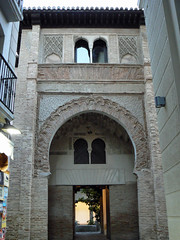 Having perhaps become a little Alhambra'd out, we headed down the hill again for a quick look round some other historic buildings in the main part of Granada, including the exterior of the cathedral, and the Corral del Carbon, a building that - despite being in current commercial use - is recognisably a medieval, Moorish-era caravanserai. Then we wandered back through the Albaicin and up to the Mirador de San Nicolas, a small square with the best views in the city - across to the Alhambra and down on the city, all with the mountains as a backdrop. It understandably seems to have become an evening hang-out for tourists and students.
Dinner that night was a simpler choice in a little bar-restaurant, including crepes and sherry.
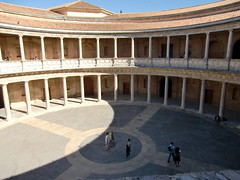 Thursday: First priority this day was to find a shop where we could pick up a new suitcase, one of ours having lost a handle in transit, and then we decided that there was only one thing to do with this last day of sightseeing; we went back into the Alhambra. We aimed to focus on the stuff we'd missed of skimmed the day before, and succeeded, taking in not only the Palacio de Carlos V (a striking Renaissance palace dropped into the middle of the older site, with a great circular court in the centre - something that would be a significant place to visit in most cities, but here ends up looking like a discrepant afterthought), but also the Museum of Fine Arts which it houses, and which is currently hosting an exhibition of Matisse's work (on the reasonable excuse that he once visited the Alhambra and was inspired thereby). Oh, and some other lesser buildings, and more gardens.
And for dinner, we decided to treat ourselves to the restaurant at the Parador de Granada, the very swish hotel within the grounds of the Alhambra. This, I'd recommend; a high-end meal with some local touches. Okay, the amuse-bouche consisting of a tiny segment of Spanish omelette was probably trying too hard, but the chilled almond and garlic soup and the roast kid were great. Angela spoke well of her tuna, too.
 Friday: The railway and airline timetables not being too full of options, we had a fairly early start (too early for the hotel's breakfast service - hey, it's Spain, they don't believe in 7am), and spent the morning descending once more into the plains of Andalucia. Then, it was a bus to Seville airport, lunch there, the flight, and a coach from Heathrow through the English rain. Hey ho, home again. At least with weather like that, we didn't regret missing any firework displays.
One snag with being a bit averse to overly hot weather - by UK standards - and thus prone to taking holidays in places that are climatically temperate, is that quite a lot of stuff that one really doesn't want to miss in a lifetime is draped around the Mediterranean.So, this year, we decided to try a workaround; taking a short break to points south in a cool month. Pictures are going up a few at a time over at my Flickr pages; consider this to be the supporting notes.
This being Spain, we had no difficulty finding a dinner quite late in the evening, albeit a snack-ish - sorry, tapas - sort of dinner, in a little nearby bar-restaurant that the guidebook suggested. And we slept okay despite a local church bell that seems to keep going on the hour and half-hour all night.
Oh, and after steering round a late-night religious procession, complete with band (just to confirm that we were in Spain, I guess), we had dinner in El Rinconcillo, which is supposed to be the oldest restaurant in the city, dating back to 1670. Decent southern Spanish stuff, I'd say. The restaurant apparently sometimes claims to be where tapas was invented, but I'd imagine a lot of Ancient Roman popina-keepers raising an eyebrow about that.
However, at some point during our three-quarter-hour wait for my dessert (a rather nice dark chocolate cake, not too sweet, accompanied by a matching custard that I'm happy to believe was actually Cava zabaglione like the menu said), long after the dessert wine had arrived and been consumed, I began to notice too much about the place. The atonal avant-garde music on the hi-fi, for a start. Then I went to the loos, which were labelled "boys" and "girls" on the door in multiple languages... Yeah, two unisex cubicles, except that the lights in one were gone and nobody was doing anything about it. On the way back to the table, I managed to suppress my invisibility-to-waiters field for long enough to prompt ours, much to his surprise, which is probably why the cake arrived before midnight. When we subsequently got the bill out of a different (but equally black-clad) waiter, it didn't include the dessert, which I chose to take as an apology- but it did include a couple of Euros for the two bread rolls which had arrived at the table automatically, as if free...
I'm prepared to believe that what we had here was a highly competent kitchen being let down by a front-of-house organisation so far up itself that those waiters only see daylight when they yawn. But then, I dunno who cocked up the dessert order (though I know who neglected to say anything to us about it). We only left a token tip, which was probably a mistake; none at all would have felt justified.
And then there was that Palace. Yup, it lives up to the hype. Well, the standard tourist route takes you through some merely impressive rooms first - then it hits you with the Court of the Myrtles, which is one of those justifies-the-trip things. The only snag with our timing was that the Court of the Lions is being massively refurbished, so we found the lions themselves in a side-room, showing off the radical clean-up that they've received, while the Court itself had a lot of scaffolding. (Made me feel like I was back in Cambridge...) Maybe we go back in a few years when they've got that little architectural gem back in full working order; even in its current state, the small forest of slender arches and carved screens still hints at the genius of the thing.
Anyway, after a stroll round the apartments where Washington Irving stayed, and the chance to admire the views and all, we wandered out into the merely superb remains of the Partal Palace, before making an indirect way to the other unique architectural masterpiece - the Generalife. (This is in the guidebooks as a separate site, but actually it's all part of the Alhambra deal.) Angela notes that you can't open a book on garden history without finding pictures of this, and it's really not hard to see why. It's kind of an exercise in gratuitously elegant Islamic garden design. With fountains. Twice. With extra beautiful stuff around it.
Dinner that night was a simpler choice in a little bar-restaurant, including crepes and sherry.
And for dinner, we decided to treat ourselves to the restaurant at the Parador de Granada, the very swish hotel within the grounds of the Alhambra. This, I'd recommend; a high-end meal with some local touches. Okay, the amuse-bouche consisting of a tiny segment of Spanish omelette was probably trying too hard, but the chilled almond and garlic soup and the roast kid were great. Angela spoke well of her tuna, too.
Saturday, October 16, 2010
Recent Reading: PS238: When Worlds Go Splat!
Somebody once pointed out that there's a problem with serial genre fiction - in any medium - which starts out as a lot of interesting images and entertaining episodes, but then goes on. What happens is that the creator feels obliged to give it some structure and a coherent plot, which has to explain all the interesting stuff from the early, incoherent episodes... And it's all downhill from then on. It happened to The X-Files, which started out with a couple of pretty FBI agents running through amusing stock horror plots and encountering weird stuff, then slumped into a tiresome and horribly extended load of drivel about horridly powerful government conspiracies which still failed to do anything about the annoying heroes (punctuated only by silly bursts of religiosity). And it happened to Planetary, which started out as a string of beautifully depicted, inexplicable episodes in which a team of super-non-heroes observed the remnants of a world of twentieth century genre fiction - then slumped into an unconvincing battle between the non-heroes and an evil but not very competent version of the Fantastic Four.
In his own way, Aaron Williams has displayed an above-average gift for handling these difficult transformations. Nodwick started out as a string of gags about an archetypical D&D party and their long-suffering, much-resurrected henchman, then turned into a moderately exciting and oddly surreal fantasy saga, which even ended before it had outstayed its welcome. And PS238 started out as a string of gags about a school for the super-gifted children of a generic superhero universe, but evolved into a genuinely readable comic. The plots actually worked as slightly twisted superhero stories, without losing track of the fact that many of the protagonists were primary-school-age kids, and the jokes remained good. Even some of the characters from the early short gag episodes developed into, well, two-and-a-half-dimensions - notably Zodon. Initially appearing as a flying-wheelchair-bound, would-be-world-conquering scientific genius who, being trapped in the body of a small child, found himself subject to a sophisticated form of parental discipline, Zodon has never exactly been a sympathetic character - he's a selfish megalomaniac intellectual snob, after all - but his frustration at being trapped in a world which he never made, and his sarcastic perceptiveness, must appeal to the long-suffering intellectual snob in us all. Even the non-powered, rather Nodwickian Tyler Marlocke, a poster child for excessive parental expectations, avoided becoming cute, but grew into a genuine child hero without losing too much of his childishness.
The latest PS238 trade paperback, When Worlds Go Splat! - volume VIII, collecting issues 40-45 of the comic - may represent a tricky and unfortunate turning-point, though. This no longer reads as the story of a school for "metaprodigies" and its pupils, but as a story about a rather blandly generic superhero universe, which happens to feature the school when it suits the plot. Much of the focus of this volume is on the origin stories of two of the parents; Atlas, who discovers that his origin is much less like that of Superman than he thought, and Emerald Gauntlet, who discovers that his origin isn't at all like that of Green Lantern, really. This brings their sons to the fore; Ron, who has at least long been a major figure in the series, but whose main feature for a while has been his troubles over his parents' divorce, and Kevin, who's never been much of a character at all. But they don't drive the plot much, and indeed, the most interesting character for much of the book is the recently-introduced Alexandra von Fogg, older sister to Zodon's chief rival, who gets to handle the smart-cynical-adult viewpoint role, while defending her family from the pious criticisms of heroic adults with a certain amount of passion.
Well, we also get more of the likeable 84, whose inferiority complex slowly seems to be coming under control. Unfortunately, there's not a lot more to her, and when much of an episode is taken up with her and Kevin running a dull maze, things really have slumped. And we get some of Tyler - but he's now been equipped with an array of gadgets by his tutor, the Revenant (Batman with the angst taken out and replaced by a little wit), enabling him to fend off Superman-level opponents on occasion, and he's been forced to accept lumps of responsibility, so he's not quite the uncomfortable, battered, sympathetic Tyler of early episodes.
Like I said, this volume makes PS238 look distressingly like an ordinary superhero comic. Even the good new minor characters - the useless Atlas 2.0 and the ludicrous Near Mint - are adults. And the need to have the characters jump into heroic action from time to time leads to some iffy moments, as when a bunch of eight-year-old kids are apparently applauded by the writer for taking on what might be an alien invasion of Earth and might be an embassy from an alien species, while two other young characters who responsibly hold back are dismissed as pathetic and lacking initiative. It's also dangerously symptomatic that the back of this book is taken up with a joke-free series of in-character descriptions of the comic's universe, which hardly seems necessary given how little it differs from the stock Marvel/DC pattern. I think that PS238 needs to go back to school.
In his own way, Aaron Williams has displayed an above-average gift for handling these difficult transformations. Nodwick started out as a string of gags about an archetypical D&D party and their long-suffering, much-resurrected henchman, then turned into a moderately exciting and oddly surreal fantasy saga, which even ended before it had outstayed its welcome. And PS238 started out as a string of gags about a school for the super-gifted children of a generic superhero universe, but evolved into a genuinely readable comic. The plots actually worked as slightly twisted superhero stories, without losing track of the fact that many of the protagonists were primary-school-age kids, and the jokes remained good. Even some of the characters from the early short gag episodes developed into, well, two-and-a-half-dimensions - notably Zodon. Initially appearing as a flying-wheelchair-bound, would-be-world-conquering scientific genius who, being trapped in the body of a small child, found himself subject to a sophisticated form of parental discipline, Zodon has never exactly been a sympathetic character - he's a selfish megalomaniac intellectual snob, after all - but his frustration at being trapped in a world which he never made, and his sarcastic perceptiveness, must appeal to the long-suffering intellectual snob in us all. Even the non-powered, rather Nodwickian Tyler Marlocke, a poster child for excessive parental expectations, avoided becoming cute, but grew into a genuine child hero without losing too much of his childishness.
The latest PS238 trade paperback, When Worlds Go Splat! - volume VIII, collecting issues 40-45 of the comic - may represent a tricky and unfortunate turning-point, though. This no longer reads as the story of a school for "metaprodigies" and its pupils, but as a story about a rather blandly generic superhero universe, which happens to feature the school when it suits the plot. Much of the focus of this volume is on the origin stories of two of the parents; Atlas, who discovers that his origin is much less like that of Superman than he thought, and Emerald Gauntlet, who discovers that his origin isn't at all like that of Green Lantern, really. This brings their sons to the fore; Ron, who has at least long been a major figure in the series, but whose main feature for a while has been his troubles over his parents' divorce, and Kevin, who's never been much of a character at all. But they don't drive the plot much, and indeed, the most interesting character for much of the book is the recently-introduced Alexandra von Fogg, older sister to Zodon's chief rival, who gets to handle the smart-cynical-adult viewpoint role, while defending her family from the pious criticisms of heroic adults with a certain amount of passion.
Well, we also get more of the likeable 84, whose inferiority complex slowly seems to be coming under control. Unfortunately, there's not a lot more to her, and when much of an episode is taken up with her and Kevin running a dull maze, things really have slumped. And we get some of Tyler - but he's now been equipped with an array of gadgets by his tutor, the Revenant (Batman with the angst taken out and replaced by a little wit), enabling him to fend off Superman-level opponents on occasion, and he's been forced to accept lumps of responsibility, so he's not quite the uncomfortable, battered, sympathetic Tyler of early episodes.
Like I said, this volume makes PS238 look distressingly like an ordinary superhero comic. Even the good new minor characters - the useless Atlas 2.0 and the ludicrous Near Mint - are adults. And the need to have the characters jump into heroic action from time to time leads to some iffy moments, as when a bunch of eight-year-old kids are apparently applauded by the writer for taking on what might be an alien invasion of Earth and might be an embassy from an alien species, while two other young characters who responsibly hold back are dismissed as pathetic and lacking initiative. It's also dangerously symptomatic that the back of this book is taken up with a joke-free series of in-character descriptions of the comic's universe, which hardly seems necessary given how little it differs from the stock Marvel/DC pattern. I think that PS238 needs to go back to school.
Tuesday, September 21, 2010
Miniature, Epic
... What have we to do
With Kaikobad the Great, or Kaikkosru?
Let Zal and Rustum bluster as they will,
Or Hatim call to supper--heed not you.
 Anyone who reads at all around medieval Persian culture or history, and who pays any attention to art credits, must get to recognise the title of the Shahnameh after a little while. In my case, it was my adolescent interest in military history that acted as the key; those flagrantly gorgeous contemporary painted depictions of the arms and armour of noble Asiatic cavalrymen usually had that title attached. It then came back from time to time, and I came to learn what the book signified; it's the Persian national epic poem, the "Book of Kings", composed in the 11th century but based on older myths. Think of a combination of the Iliad, the Odyssey, the Matter of Britain and the legends of Hercules, and you'll get the idea. Except that, as this one was immensely popular in much of the Islamic world for several centuries, it frequently appeared in exquisitely illuminated forms.
So when the Fitzwilliam Museum in Cambridge runs an exhibition entitled Epic of the Persian Kings: The Art of Ferdowsi’s Shahnameh, what they're actually offering is a couple of rooms full of classic Persian and Indian miniature painting (plus a few ceramics and such for variety). It's not a grand or sweeping theme - it's quite tightly focused, really - but it's well worth an hour or two, even at the level of casual and under-informed browsing and contemplation. And, to be fair, the museum's labeling does a fair job of making up for any visitor ignorance.
Not that one gets an especially full feeling for the full plot of the Shahnameh, mind. That's not the point of the exercise, and it seems that certain specific scenes from this lengthy epic were especially favoured by artists (or maybe by the curators of this exhibition). The great hero Rustam, his very superior horse Rakhsh, and his tragic duel with his unrecognised son Sorab, recur frequently, as does the scene of the night of Sorab's conception. (A princess in a castle where Rustam has taken shelter comes to visit him in the night, seeking to bear a hero's son.) Yeah, all the classic stuff - violence, tragedy, sex - and especially the bits where those themes emerge turned up to 11. I'm not sure where the recurrent scene of one hero fishing another out of a deep dark pit fits in with this pattern, though maybe the Freudians could have some fun with it.
The feel is thus quite reminiscent of the Arthurian cycle, at least at that level, but the art styles throughout this exhibition are distinctly eastern, with reams of beautiful calligraphy on pages dusted with gold and embellished with richly coloured inks. This does lead to problems for the show, mind; all these centuries-old books obviously need very careful treatment, so the room lighting is kept respectfully low, so maybe it's hard to catch the full impact of the artistry. The illustrated books and postcards on sale in the gift shop may actually provide a better clue as to the sheer technicolor pizazz of this artistic tradition. Still, there's a lot of rarefied boasting points to be had from seeing all those originals gathered together.
With Kaikobad the Great, or Kaikkosru?
Let Zal and Rustum bluster as they will,
Or Hatim call to supper--heed not you.
So when the Fitzwilliam Museum in Cambridge runs an exhibition entitled Epic of the Persian Kings: The Art of Ferdowsi’s Shahnameh, what they're actually offering is a couple of rooms full of classic Persian and Indian miniature painting (plus a few ceramics and such for variety). It's not a grand or sweeping theme - it's quite tightly focused, really - but it's well worth an hour or two, even at the level of casual and under-informed browsing and contemplation. And, to be fair, the museum's labeling does a fair job of making up for any visitor ignorance.
Not that one gets an especially full feeling for the full plot of the Shahnameh, mind. That's not the point of the exercise, and it seems that certain specific scenes from this lengthy epic were especially favoured by artists (or maybe by the curators of this exhibition). The great hero Rustam, his very superior horse Rakhsh, and his tragic duel with his unrecognised son Sorab, recur frequently, as does the scene of the night of Sorab's conception. (A princess in a castle where Rustam has taken shelter comes to visit him in the night, seeking to bear a hero's son.) Yeah, all the classic stuff - violence, tragedy, sex - and especially the bits where those themes emerge turned up to 11. I'm not sure where the recurrent scene of one hero fishing another out of a deep dark pit fits in with this pattern, though maybe the Freudians could have some fun with it.
The feel is thus quite reminiscent of the Arthurian cycle, at least at that level, but the art styles throughout this exhibition are distinctly eastern, with reams of beautiful calligraphy on pages dusted with gold and embellished with richly coloured inks. This does lead to problems for the show, mind; all these centuries-old books obviously need very careful treatment, so the room lighting is kept respectfully low, so maybe it's hard to catch the full impact of the artistry. The illustrated books and postcards on sale in the gift shop may actually provide a better clue as to the sheer technicolor pizazz of this artistic tradition. Still, there's a lot of rarefied boasting points to be had from seeing all those originals gathered together.
Gone Postal
Going Postal, the third of Sky's adaptations of Terry Pratchett's Discworld novels (recently released on DVD), is the first that really seems to work quite right. The first two (Hogfather and The Colour of Magic) had their virtues, but the problem with genre fantasy on screen is that it's hard to avoid it looking silly, in a bad-'80s-Conan-clone sort of way - all those robes and swords and medieval towns are hard to make convincing, and "It's meant to be a joke!" doesn't save things the way it does on the page. With a recent Discworld novel like this one, however, the style of the setting has moved forward through history very significantly, and the production design could go for something much more Victorian than cod-medieval - which looks fine, even cool, without being unduly distracting. This in turn means that, for example, the cast could be as ludicrously good as in the earlier movies, while looking like a bunch of good actors who've been cast for their suitability for the roles, rather than a bunch of famous thesps doing panto. They were clearly able to get their heads around their lines and deliver them with some conviction, rather than seeming to wonder what they were doing here.
The two leads - Richard Coyle as Moist von Lipwig and Claire Foy as Adora Belle Dearheart - weren't the most famous of these people, of course (that would probably be Charles Dance, completely walking it with casual ease as the Patrician), but both managed very well indeed. Special mention, though, has to go to the perfectly chosen Tamsin Greig as Sacharissa Cripslock - a piece of casting that makes me dream of a prequel production of The Truth, just to see Greig playing Sacharissa as a developing character rather than a cameo/plot device.
Of course, compressing a full novel into three hours of film requires a certain amount of brutal surgery, which was mostly executed quite well here, leaving a film that worked on its own terms - although the psychic power of the undelivered letters ended up seeming less subtle, and the big emotional thrust of the book - Moist's redemption and discovery of his own conscience - certainly became a much cruder process, being largely forced on him by visions inflicted by the letters (rather nicely depicted in the form of black-and-white silent movies, but still). Likewise, Adora Belle seemed slightly softened - she was still a dangerous character, but her hardness was depicted entirely as a reaction to family tragedy; likewise, perhaps inevitably these days, her cigarette addiction was shown as coming from the same source and as something she really needs to discard, rather than being an integral feature of her character which Moist's emerging masochistic side could find attractive. Less crucially, but rather sadly perhaps, there was no room for Anghammarad the Golem, while Moist's visit to Unseen University was gone, its expository role being filled by a visit from Archchancellor Ridcully - giving us the joy of Timothy West in that particular role, but should the Archchancellor show up in the Post Office at the beck and call of a golem?
But that's quibbling - and a really successful screen adaptation of a Discworld novel is too good a thing to deserve excessive quibbles. If Sky are going to continue doing these adaptations once a year, I hope that this one sets a pattern.
The two leads - Richard Coyle as Moist von Lipwig and Claire Foy as Adora Belle Dearheart - weren't the most famous of these people, of course (that would probably be Charles Dance, completely walking it with casual ease as the Patrician), but both managed very well indeed. Special mention, though, has to go to the perfectly chosen Tamsin Greig as Sacharissa Cripslock - a piece of casting that makes me dream of a prequel production of The Truth, just to see Greig playing Sacharissa as a developing character rather than a cameo/plot device.
Of course, compressing a full novel into three hours of film requires a certain amount of brutal surgery, which was mostly executed quite well here, leaving a film that worked on its own terms - although the psychic power of the undelivered letters ended up seeming less subtle, and the big emotional thrust of the book - Moist's redemption and discovery of his own conscience - certainly became a much cruder process, being largely forced on him by visions inflicted by the letters (rather nicely depicted in the form of black-and-white silent movies, but still). Likewise, Adora Belle seemed slightly softened - she was still a dangerous character, but her hardness was depicted entirely as a reaction to family tragedy; likewise, perhaps inevitably these days, her cigarette addiction was shown as coming from the same source and as something she really needs to discard, rather than being an integral feature of her character which Moist's emerging masochistic side could find attractive. Less crucially, but rather sadly perhaps, there was no room for Anghammarad the Golem, while Moist's visit to Unseen University was gone, its expository role being filled by a visit from Archchancellor Ridcully - giving us the joy of Timothy West in that particular role, but should the Archchancellor show up in the Post Office at the beck and call of a golem?
But that's quibbling - and a really successful screen adaptation of a Discworld novel is too good a thing to deserve excessive quibbles. If Sky are going to continue doing these adaptations once a year, I hope that this one sets a pattern.
Friday, September 17, 2010
Miniature Architecture

I think I've seen similar before, but it's still mildly weird. An emergent product of whatever it is that ants do to optimise their nest systems, of course.
Thursday, September 16, 2010
Scott Pilgrim vs. the World
Going to see this was in large part an exercise in trying to get the hang of what the kids like these days. I knew in advance that it would really require a working knowledge of things like video games (which I don't have) to get most of the jokes, and I gathered that the whole thing was probably largely about the experience of being young (which I'm not). However, I write and edit roleplaying games material for a living (of sorts), and this is clearly the geek thing of the moment, so I feel a certain obligation to keep up with some of the references.
Plus, I can't help but feel a certain admiration for the work of Edgar Wright, going back to (and still largely focused on) the classic TV Spaced, so I was curious about this movie.
And, yes, it was genuinely entertaining, even if I didn't happen to know exactly which video games involve those particular martial arts movies, or defeated opponents disintegrating into coins, or whatever. (And, okay, no, I haven't read the Scott Pilgrim comics either, mea culpa.) Like Spaced, this film finds the essential, universal comedy in a specific and personal situation - and doesn't bother denying the essential comic gormlessness of the archetypal slacker-geek - so one doesn't need to get every reference to get enough of the jokes. I laughed, I might have cheered a bit, I didn't feel that I'd wasted my time.
The only thing that I would say is that the plot suffered slightly from the standard problem of slacker-romantic-comedies; with a male lead who's a bit of a clueless loser, it's hard to see what the self-assured, assertive love object was supposed to see in him. Admittedly, in this case, said object of desire had her own problems - the standard reading of the plot seems to be that it's really all about helping her to get over her hang-ups and to get rid of the ghosts of her past - but at least those are adult sorts of problem; compared to somebody who'd moved from city to city, learned to at least recognise her own emotional failings, and acquired some kind of proper paying job (making her "kinda hardcore"), Scott Pilgrim is just a child. Compare and contrast, say, Spaced, in which most of the characters have some kind of viable employment while all being at approximately the same level of psychological incompetence.
But, heck, the visual gags and stylistic tics were quite funny (see the aggressive female character who's perforce acquired the ability to generate her own verbal censorship effects) and occasionally clever, as were some of the one-liners (such as their drummer's introductions to Sex Bob Bomb's various performances). And I spotted the Princess Bride reference. If we're going to have stylistically flashy slacker-rom-coms for the video game generations, this will do for a start.
Plus, I can't help but feel a certain admiration for the work of Edgar Wright, going back to (and still largely focused on) the classic TV Spaced, so I was curious about this movie.
And, yes, it was genuinely entertaining, even if I didn't happen to know exactly which video games involve those particular martial arts movies, or defeated opponents disintegrating into coins, or whatever. (And, okay, no, I haven't read the Scott Pilgrim comics either, mea culpa.) Like Spaced, this film finds the essential, universal comedy in a specific and personal situation - and doesn't bother denying the essential comic gormlessness of the archetypal slacker-geek - so one doesn't need to get every reference to get enough of the jokes. I laughed, I might have cheered a bit, I didn't feel that I'd wasted my time.
The only thing that I would say is that the plot suffered slightly from the standard problem of slacker-romantic-comedies; with a male lead who's a bit of a clueless loser, it's hard to see what the self-assured, assertive love object was supposed to see in him. Admittedly, in this case, said object of desire had her own problems - the standard reading of the plot seems to be that it's really all about helping her to get over her hang-ups and to get rid of the ghosts of her past - but at least those are adult sorts of problem; compared to somebody who'd moved from city to city, learned to at least recognise her own emotional failings, and acquired some kind of proper paying job (making her "kinda hardcore"), Scott Pilgrim is just a child. Compare and contrast, say, Spaced, in which most of the characters have some kind of viable employment while all being at approximately the same level of psychological incompetence.
But, heck, the visual gags and stylistic tics were quite funny (see the aggressive female character who's perforce acquired the ability to generate her own verbal censorship effects) and occasionally clever, as were some of the one-liners (such as their drummer's introductions to Sex Bob Bomb's various performances). And I spotted the Princess Bride reference. If we're going to have stylistically flashy slacker-rom-coms for the video game generations, this will do for a start.
Stockholm Photos
I've finally finished uploading a photo diary of sorts of our holiday in Stockholm last month on Flickr:
I probably ended up posting more pictures than I should have, my selections may be a bit arbitrary or sloppy in places, and I'll leave it to others to judge my editing and post-processing. But it was a good holiday, and Angela and I both photographed some interesting stuff.
I probably ended up posting more pictures than I should have, my selections may be a bit arbitrary or sloppy in places, and I'll leave it to others to judge my editing and post-processing. But it was a good holiday, and Angela and I both photographed some interesting stuff.
Wednesday, September 15, 2010
Recent Reading: Alexandria
by Lindsey Davis
I've been picking up Lindsey Davis's Falco novels - when the paperbacks appear - since forever, but really just as light reading. Even by those standards, though, this one is a lightweight. Falco and immediate family make their way to Alexandria-in-Egypt, stay with some more distant family, meet some people from the library, and run into a murder mystery, which eventually gets sorted out in a rather discursive fashion. Then they go home again.
The book seems to exist for two reasons; to let Davis unload some research she's done about Roman Alexandria in a moderately entertaining fashion, and to allow her a small joke about detective story forms. The Falco stories started out as time-displaced hard-boiled noir exercises with a reasonable amount of grit, but as the hero has settled down as a family man, and Davis has come ever more fond of her supporting cast, the requisite darkness has rather faded. Here, in fact, we get (a) a body in a library, and (b) a locked room murder mystery. But Davis can't do Christie-esque cosy puzzles particularly well, I'm afraid. The best scenes are actually a couple of set-pieces involving sudden death and night-time chases through the streets, which may not achieve serious levels of tension, but at least manage to be interesting.
I gather that the next in the series involves a return to Rome - and with any luck, we'll get Falco's honest-cop pal Petro back, and maybe a few brutal gangsters and some cynical court politics on the mean streets around the Aventine. Then, I'll feel less like my time-filler is a time-waster.
I've been picking up Lindsey Davis's Falco novels - when the paperbacks appear - since forever, but really just as light reading. Even by those standards, though, this one is a lightweight. Falco and immediate family make their way to Alexandria-in-Egypt, stay with some more distant family, meet some people from the library, and run into a murder mystery, which eventually gets sorted out in a rather discursive fashion. Then they go home again.
The book seems to exist for two reasons; to let Davis unload some research she's done about Roman Alexandria in a moderately entertaining fashion, and to allow her a small joke about detective story forms. The Falco stories started out as time-displaced hard-boiled noir exercises with a reasonable amount of grit, but as the hero has settled down as a family man, and Davis has come ever more fond of her supporting cast, the requisite darkness has rather faded. Here, in fact, we get (a) a body in a library, and (b) a locked room murder mystery. But Davis can't do Christie-esque cosy puzzles particularly well, I'm afraid. The best scenes are actually a couple of set-pieces involving sudden death and night-time chases through the streets, which may not achieve serious levels of tension, but at least manage to be interesting.
I gather that the next in the series involves a return to Rome - and with any luck, we'll get Falco's honest-cop pal Petro back, and maybe a few brutal gangsters and some cynical court politics on the mean streets around the Aventine. Then, I'll feel less like my time-filler is a time-waster.
Friday, September 10, 2010
Recent Reading: Rainbows End
by Vernor Vinge
I picked this up a few months back, but I took a while to finish it, with various interruptions - which may be a sign about how much enthusiasm it didn't inspire in me, but could of course just be a sign of the men-over-45-don't-read-many-novels syndrome.
I was interested in it because I've quite liked some Vinge I've read in the past, and I was curious as to what he would do, as a fairly seriously hard SF writer with an interest in genuine futurology, with a near-future setting. The problem, perhaps, is that what he does is a bit too much like some of his far-future stories. He wants to tell a sprawling multi-stranded tale of wonders, but he tries to cram it into the more constraining bounds of an international espionage tale and a school story.
Yes, both. The plots are also crammed together with a story about an aged Alzheimer's victim who turns out to respond exceptionally well to new medical treatments, and who therefore finds himself more or less restored to youth. The strands are interlocked moderately competently - the restored geriatric is obliged to attend the school in order to learn his way around the brave new world of 2020-ish, allowing for a certain amount of low key touring of the balloon factory, while his family become the key to a multi-layered espionage plot - but there's a sense of excessive coincidence, and some moderately odd behaviour from one or two characters that mostly happens to drive the plot. Vinge plays with some interesting ideas about near-future developments in computer interfaces and large-scale networked decision support, but this leads to some odd, unexamined problems; for example, if a character is engaging in a deeply secret, incredibly illegal and morally dubious long-term project, could he really maintain a large network of online consultant-advisers without worrying whether one or two of them might, you know, work out what they're involved in and blow the whistle in a fit of conscience?
In fact, the human elements are some of the least convincing parts of this story. The central character, the rejuvenated geriatric, comes across as an annoyed hard-science academic's parody of an annoying, self-indulgent artist-intellectual, and is only patchily convincing, either in himself or in his response to his situation. We also get the bizarre situation of a school full of teenagers, plus some elderly people in newly youthful bodies, one of them that self-indulgent, emotionally manipulative poet-intellectual, where nobody even seems to think about sex for almost all of the book. I wasn't look for soft porn or bad comedy, but I was looking for either plausible human behaviour or some explanation why human norms might have changed so radically by this point in the near future. But answer came there none. Libido suppressants in the water supply, maybe.
Vinge's view of the information-saturated future isn't that deep, either. After most of the book has talked about such matters, the climactic scene is largely driven by someone's attempts to extract a physical object from a sealed location - a physical maguffin whose information content is all that matters, really. Also, about half-way through the book, some of the characters discuss whether one of the others might be, well, something which William Gibson established as a bit of a cyberpunk cliche decades ago. The characters dismiss the idea out of hand. It's not giving away much to say that it seemingly turns out to be correct. How this could have come about in the time between now and the novel's present isn't very clear to me, mind, but that's another of Vinge's problems; he wants all these wonderful things to have come into existence in the near future, but his plot needs them to have been around for a fairly long time, so that they can have had consequences. (It also needs a few moderately substantial political shifts, such as India becoming a global power player.)
The novel does have some decent ideas, and one or two characters it's possible to care about, for good or ill, even if a lot of them are a bunch of smug, shallow technocrats. But then, in the end, it shambles to a slightly confused and incomplete conclusion, leaving the fate of some of those characters unclear and with enough semi-loose ends that I wonder if we're supposed to be looking for a sequel. I'm not, though, really; I suspect that Vinge is at his best when he looks into the far rather than the near future. It's a shame; I was hoping that he could write short, snappy books that I could enjoy, as well as his interesting but physical-strain-inducing doorstops, and I hoped that he could do some good near-term futurology. But he's really not as sharp or convincing as, say, Greg Egan, or the better cyberpunks; for all his forward-looking pose, he's an older-generation skiffy writer, and it shows.
I picked this up a few months back, but I took a while to finish it, with various interruptions - which may be a sign about how much enthusiasm it didn't inspire in me, but could of course just be a sign of the men-over-45-don't-read-many-novels syndrome.
I was interested in it because I've quite liked some Vinge I've read in the past, and I was curious as to what he would do, as a fairly seriously hard SF writer with an interest in genuine futurology, with a near-future setting. The problem, perhaps, is that what he does is a bit too much like some of his far-future stories. He wants to tell a sprawling multi-stranded tale of wonders, but he tries to cram it into the more constraining bounds of an international espionage tale and a school story.
Yes, both. The plots are also crammed together with a story about an aged Alzheimer's victim who turns out to respond exceptionally well to new medical treatments, and who therefore finds himself more or less restored to youth. The strands are interlocked moderately competently - the restored geriatric is obliged to attend the school in order to learn his way around the brave new world of 2020-ish, allowing for a certain amount of low key touring of the balloon factory, while his family become the key to a multi-layered espionage plot - but there's a sense of excessive coincidence, and some moderately odd behaviour from one or two characters that mostly happens to drive the plot. Vinge plays with some interesting ideas about near-future developments in computer interfaces and large-scale networked decision support, but this leads to some odd, unexamined problems; for example, if a character is engaging in a deeply secret, incredibly illegal and morally dubious long-term project, could he really maintain a large network of online consultant-advisers without worrying whether one or two of them might, you know, work out what they're involved in and blow the whistle in a fit of conscience?
In fact, the human elements are some of the least convincing parts of this story. The central character, the rejuvenated geriatric, comes across as an annoyed hard-science academic's parody of an annoying, self-indulgent artist-intellectual, and is only patchily convincing, either in himself or in his response to his situation. We also get the bizarre situation of a school full of teenagers, plus some elderly people in newly youthful bodies, one of them that self-indulgent, emotionally manipulative poet-intellectual, where nobody even seems to think about sex for almost all of the book. I wasn't look for soft porn or bad comedy, but I was looking for either plausible human behaviour or some explanation why human norms might have changed so radically by this point in the near future. But answer came there none. Libido suppressants in the water supply, maybe.
Vinge's view of the information-saturated future isn't that deep, either. After most of the book has talked about such matters, the climactic scene is largely driven by someone's attempts to extract a physical object from a sealed location - a physical maguffin whose information content is all that matters, really. Also, about half-way through the book, some of the characters discuss whether one of the others might be, well, something which William Gibson established as a bit of a cyberpunk cliche decades ago. The characters dismiss the idea out of hand. It's not giving away much to say that it seemingly turns out to be correct. How this could have come about in the time between now and the novel's present isn't very clear to me, mind, but that's another of Vinge's problems; he wants all these wonderful things to have come into existence in the near future, but his plot needs them to have been around for a fairly long time, so that they can have had consequences. (It also needs a few moderately substantial political shifts, such as India becoming a global power player.)
The novel does have some decent ideas, and one or two characters it's possible to care about, for good or ill, even if a lot of them are a bunch of smug, shallow technocrats. But then, in the end, it shambles to a slightly confused and incomplete conclusion, leaving the fate of some of those characters unclear and with enough semi-loose ends that I wonder if we're supposed to be looking for a sequel. I'm not, though, really; I suspect that Vinge is at his best when he looks into the far rather than the near future. It's a shame; I was hoping that he could write short, snappy books that I could enjoy, as well as his interesting but physical-strain-inducing doorstops, and I hoped that he could do some good near-term futurology. But he's really not as sharp or convincing as, say, Greg Egan, or the better cyberpunks; for all his forward-looking pose, he's an older-generation skiffy writer, and it shows.
Tuesday, September 07, 2010
Theatre: Twelfth Night
Cambridge Shakespeare Festival, 28/8/2010
(Note to self; you enjoy Cambridge Shakespeare Festival productions, Philip, so you really should get to them earlier in the year. The last night of the last performance looks like brinkmanship. Fortunately, the weather held, this time.)
And it's back to Robinson College gardens for another comedy - more unambiguously comic than last year's, mind. It's still a nice venue for theatre on a nice evening, although this production doesn't seem quite to have got the hang of working with the space - lines were getting lost in the shrubbery, cast members were trying to interact from too far apart. Still, mostly, they were pretty good. Mind you, I've seen some not-very-similar Violas and Sebastians in my time, but these two really were exceptional - about a foot apart in height, and with no other similarities. Hey ho, accept the theatrical convention.
The director's line here seemed to be that Illyria is almost entirely inhabited by foppish loons - not just Sir Toby and Sir Andrew, Duke Orsino is pretty much as bad. This explains why Olivia isn't very interested in him - she's trying to be a sensible person and is still genuinely in mourning, but none of the aristocratic layabouts around her will be sensible - and why she falls so promptly for Viola/Cesario, who acts moderately seriously as well as being quite charismatic. (This Olivia then flips over into a state of girlish lust, abandoning black like a shot now she's got someone she can be cheerful rather than silly with, but then throwing herself very energetically at the object of her affections, which must be nice for Sebastian when she grabs him but doesn't look very consistent.) However, this then leaves a problem of explaining why the smart Viola should fall for the goofy Orsino... I know, she just does, okay? It's a Shakespeare comedy.
And, to be fair, quite funny in this production - notoriously not always the way with Shakespeare comedies, and not just because of Malvolio's character story (marginalised at the end in a faintly embarrassed way here). The Shakespeare Festival continues to make Shakespeare productions that are worth going to see. Must try to get to it more efficiently next year.
(Note to self; you enjoy Cambridge Shakespeare Festival productions, Philip, so you really should get to them earlier in the year. The last night of the last performance looks like brinkmanship. Fortunately, the weather held, this time.)
And it's back to Robinson College gardens for another comedy - more unambiguously comic than last year's, mind. It's still a nice venue for theatre on a nice evening, although this production doesn't seem quite to have got the hang of working with the space - lines were getting lost in the shrubbery, cast members were trying to interact from too far apart. Still, mostly, they were pretty good. Mind you, I've seen some not-very-similar Violas and Sebastians in my time, but these two really were exceptional - about a foot apart in height, and with no other similarities. Hey ho, accept the theatrical convention.
The director's line here seemed to be that Illyria is almost entirely inhabited by foppish loons - not just Sir Toby and Sir Andrew, Duke Orsino is pretty much as bad. This explains why Olivia isn't very interested in him - she's trying to be a sensible person and is still genuinely in mourning, but none of the aristocratic layabouts around her will be sensible - and why she falls so promptly for Viola/Cesario, who acts moderately seriously as well as being quite charismatic. (This Olivia then flips over into a state of girlish lust, abandoning black like a shot now she's got someone she can be cheerful rather than silly with, but then throwing herself very energetically at the object of her affections, which must be nice for Sebastian when she grabs him but doesn't look very consistent.) However, this then leaves a problem of explaining why the smart Viola should fall for the goofy Orsino... I know, she just does, okay? It's a Shakespeare comedy.
And, to be fair, quite funny in this production - notoriously not always the way with Shakespeare comedies, and not just because of Malvolio's character story (marginalised at the end in a faintly embarrassed way here). The Shakespeare Festival continues to make Shakespeare productions that are worth going to see. Must try to get to it more efficiently next year.
Thursday, September 02, 2010
Expand, Contract (26)
Well, one of the big-ish Transhuman Space projects has now progressed to the rough layout stage. Looks highly promising.
Edit: As Kromm has now revealed the title in his blog, I can happily confirm that this book is Cities on the Edge, by Anders Sandberg and Waldemar Ingdahl.
And I have a fully signed contract for the big project which I can't really talk about yet, but which may make these sorts of posts relatively infrequent for a while (while making me quite happy).
Edit: As Kromm has now revealed the title in his blog, I can happily confirm that this book is Cities on the Edge, by Anders Sandberg and Waldemar Ingdahl.
And I have a fully signed contract for the big project which I can't really talk about yet, but which may make these sorts of posts relatively infrequent for a while (while making me quite happy).
Tuesday, August 31, 2010
Toy Story 3
First, the easy bit. This film is brilliant. Funny, fast-paced, ironical - people have talked about Wall-E or Up being among the major films of their years, but to my mind, this is the big-time computer animation that really has a claim for that sort of standing; notably, when it tries to be moving, it usually does so without being too blatantly manipulative.
However, it also left me glad that I don't have children, because that means that I didn't have to try and explain this film to them. Aside from the fact that the whole thing is about maturity and loss and the prospect of death, there are the three-eyed green blobs with their religious obsessions and eventual apotheosis, or Buzz's Spanish alternate persona and its curious appeal for Jessie. One also imagines generations of children growing up into their first encounters with the prison movie and PoW film genres, and suddenly realising what much of this thing was all about - and that's not just the minor cliches, it's also big-ish things about the corruptions of petty power. The film's direction also repeatedly employs the semantics of the horror genre, with the blank-eyed zombie Big Baby and the culminating plunge towards a hellish pit. And, of course, there's Ken, concerning whom one might choose to explain subtle concepts like metrosexuality and '70s disco fashion to the sprogs, if one wanted to get more complicated than just saying that he's evidently gay. All this is much of the point of the movie, mind, and I think that it's in more danger of befuddling kids than of seriously traumatising them, but it really does feel like a film about a box full of toys, written for a non-child audience - something that may confuse some parents as well as their offspring.
I saw it in 3-D, incidentally, and that proved unintrusive without being at all necessary in this case. Which I guess could be taken as the sign of maturity in the technology, or just money wasted.
However, it also left me glad that I don't have children, because that means that I didn't have to try and explain this film to them. Aside from the fact that the whole thing is about maturity and loss and the prospect of death, there are the three-eyed green blobs with their religious obsessions and eventual apotheosis, or Buzz's Spanish alternate persona and its curious appeal for Jessie. One also imagines generations of children growing up into their first encounters with the prison movie and PoW film genres, and suddenly realising what much of this thing was all about - and that's not just the minor cliches, it's also big-ish things about the corruptions of petty power. The film's direction also repeatedly employs the semantics of the horror genre, with the blank-eyed zombie Big Baby and the culminating plunge towards a hellish pit. And, of course, there's Ken, concerning whom one might choose to explain subtle concepts like metrosexuality and '70s disco fashion to the sprogs, if one wanted to get more complicated than just saying that he's evidently gay. All this is much of the point of the movie, mind, and I think that it's in more danger of befuddling kids than of seriously traumatising them, but it really does feel like a film about a box full of toys, written for a non-child audience - something that may confuse some parents as well as their offspring.
I saw it in 3-D, incidentally, and that proved unintrusive without being at all necessary in this case. Which I guess could be taken as the sign of maturity in the technology, or just money wasted.
Tuesday, August 24, 2010
Sherlock
Sherlock definitely accomplished what it set out to do - to update Sherlock Holmes and his surrounding myth to the 21st century. Benedict Cumberbatch and Martin Freeman were good enough as Holmes and Watson that I wondered vaguely how they'd do in a period-costume version, although Holmes's nigh-sociopathic callousness was maybe over-emphasised - the original would at least observe the social niceties when interviewing a distressed client, and would sternly declare his opponents to be abominable before diving into the clues. Maybe someone thought that this was just a mask, and a modern Holmes wouldn't bother. Meanwhile, the scriptwriters had enormous fun working stuff from the original stories into the modern-day version, doubtless seeing how much they could include that would make the people who just think they know Holmes accuse them of gross distortion before the people who've actually read the stories jumped in to point out the truth.
But oh dear, it was rushed. I got the feeling that the writers wanted a full multi-week series and pitched a story arc on that assumption - and the BBC said "great, you can give us that in three 90-minute episodes". So in the first episode, we got the Big Meeting and the basic relationships framework, and Holmes heard the name "Moriarty"; in the second, Holmes cracked a case (with the aid of one stonking big coincidence, if you were paying attention) and unbeknown to him, the leader of the villains was collaborating with someone who signed himself "M" and who employed a sniper (doubtless name of Moran), and in the third, Moriarty decided that Holmes was both threat enough and entertaining enough that he gave him an episode's worth of arbitrary puzzles at huge cost to himself and his credibility, then emerged from the shadows to reveal himself to be a bit of a loony, eventually setting up an arbitrary To Be Continued.
Okay, now BBC; it works, okay? That much should have been obvious from the first, but anyway, if you're prepared to believe it now, give Moffat and Gatiss at least a dozen or so episodes to expand into, let them wrap up the Moriarty nonsense with one mighty bound in the first (Moriarty was always a dull and cumbersome element to the original Holmes mythos, after all - making him a big feature of the modern version was a bit lazy), and let's see Cumberbatch and Freeman weave their intellectually sinuous way across modern London the way that Jeremy Brett and Edward Hardwicke made Victorian-Edwardian London look so damn good.
Otherwise, don't bother.
But oh dear, it was rushed. I got the feeling that the writers wanted a full multi-week series and pitched a story arc on that assumption - and the BBC said "great, you can give us that in three 90-minute episodes". So in the first episode, we got the Big Meeting and the basic relationships framework, and Holmes heard the name "Moriarty"; in the second, Holmes cracked a case (with the aid of one stonking big coincidence, if you were paying attention) and unbeknown to him, the leader of the villains was collaborating with someone who signed himself "M" and who employed a sniper (doubtless name of Moran), and in the third, Moriarty decided that Holmes was both threat enough and entertaining enough that he gave him an episode's worth of arbitrary puzzles at huge cost to himself and his credibility, then emerged from the shadows to reveal himself to be a bit of a loony, eventually setting up an arbitrary To Be Continued.
Okay, now BBC; it works, okay? That much should have been obvious from the first, but anyway, if you're prepared to believe it now, give Moffat and Gatiss at least a dozen or so episodes to expand into, let them wrap up the Moriarty nonsense with one mighty bound in the first (Moriarty was always a dull and cumbersome element to the original Holmes mythos, after all - making him a big feature of the modern version was a bit lazy), and let's see Cumberbatch and Freeman weave their intellectually sinuous way across modern London the way that Jeremy Brett and Edward Hardwicke made Victorian-Edwardian London look so damn good.
Otherwise, don't bother.
Friday, August 20, 2010
Notes from a Holiday
Angela having a couple of weeks booked off, it was time for a break.
Starting, on the last day of July, with a day at the Cambridge Folk Festival. This was less laden with names I knew in advance than previous years, I must admit, which didn't make it any less fun - and at least the weather was decent, the day we happened to be there. I quite enjoyed Pink Martini - I know that some people wouldn't consider them to be folk, to an even greater extent than a lot of performers who show up at the Festival, but hey, I'm happy to regard 1930s lounge lizards who like doing covers of Ravel's Bolero as my kind of folk - while Kathy Mattea, doing what seemed to my untrained ear like a traditional sort of American folk-country, with a lot of songs about coal mining, was very good at what she did. Anyway, a good day.
The next day (our wedding anniversary) was lunch with friends, and the day after that was packing, because on the Tuesday, we flew out to Stockholm. I'm mostly going to record this in the form of a photo log on Flickr, which is still a work in progress right now, and may take a while to finish (I have a lot of digital images to sort through and tweak), but anyway, for the record, we stayed in the Hotel Rival (strongly recommended, even at the cost of directing yet more cash into the great Abba money maw - and by the way, if the Swedes are so proud of their internationally successful exports, how come I kept seeing references to Abba but none to the Cardigans?), which was located in Sodermalm, Stockholm's Bohemian quarter. By the way, "Bohemian" in Swedish turns out to mean "was poor working-class a few hundred years ago, and now has rather a good selection of nice little restaurants".
Stockholm actually turned out to be a great city for a holiday, if not the cheapest place to eat (and an even more expensive place to drink, thanks to the Swedish government's tax-based attempts to stope the Swedish people from drinking to dull the pain of living in an orderly, prosperous society). The generous supplies of good-quality coffee, sometimes actually free, compensated somewhat for that. The preferred building style often suggested a peculiar fixation on Renaissance Italy - a better model than most, in truth, although the local light wasn't exactly Mediterranean in intensity, which maybe reduced the effect rather - but the city's real advantage is that it's wrapped round and threaded through a lake and bay and archipelago; there was a feeling that the first thing one should do each morning was check which cruise liners were dominating the skyline that day.
Highest points of the holiday included the extraordinarily well-preserved centuries-old ship Vasa in its own museum, ascending the tower of the fortress at Vaxholmen for a beautiful view over the inner archipelago on a summer day, and strolling round the extraordinary outdoor museum and zoo at Skansen. Anyway, a good ten days.
And then it was back home.
Starting, on the last day of July, with a day at the Cambridge Folk Festival. This was less laden with names I knew in advance than previous years, I must admit, which didn't make it any less fun - and at least the weather was decent, the day we happened to be there. I quite enjoyed Pink Martini - I know that some people wouldn't consider them to be folk, to an even greater extent than a lot of performers who show up at the Festival, but hey, I'm happy to regard 1930s lounge lizards who like doing covers of Ravel's Bolero as my kind of folk - while Kathy Mattea, doing what seemed to my untrained ear like a traditional sort of American folk-country, with a lot of songs about coal mining, was very good at what she did. Anyway, a good day.
The next day (our wedding anniversary) was lunch with friends, and the day after that was packing, because on the Tuesday, we flew out to Stockholm. I'm mostly going to record this in the form of a photo log on Flickr, which is still a work in progress right now, and may take a while to finish (I have a lot of digital images to sort through and tweak), but anyway, for the record, we stayed in the Hotel Rival (strongly recommended, even at the cost of directing yet more cash into the great Abba money maw - and by the way, if the Swedes are so proud of their internationally successful exports, how come I kept seeing references to Abba but none to the Cardigans?), which was located in Sodermalm, Stockholm's Bohemian quarter. By the way, "Bohemian" in Swedish turns out to mean "was poor working-class a few hundred years ago, and now has rather a good selection of nice little restaurants".
Stockholm actually turned out to be a great city for a holiday, if not the cheapest place to eat (and an even more expensive place to drink, thanks to the Swedish government's tax-based attempts to stope the Swedish people from drinking to dull the pain of living in an orderly, prosperous society). The generous supplies of good-quality coffee, sometimes actually free, compensated somewhat for that. The preferred building style often suggested a peculiar fixation on Renaissance Italy - a better model than most, in truth, although the local light wasn't exactly Mediterranean in intensity, which maybe reduced the effect rather - but the city's real advantage is that it's wrapped round and threaded through a lake and bay and archipelago; there was a feeling that the first thing one should do each morning was check which cruise liners were dominating the skyline that day.
Highest points of the holiday included the extraordinarily well-preserved centuries-old ship Vasa in its own museum, ascending the tower of the fortress at Vaxholmen for a beautiful view over the inner archipelago on a summer day, and strolling round the extraordinary outdoor museum and zoo at Skansen. Anyway, a good ten days.
And then it was back home.
Subscribe to:
Posts (Atom)
